Section heading
Before
My Career Story
After
Experience
A seven-step workflow that takes the median CV from 48 to 80+ on ATS scoring. With the fixes ranked by impact, real before-and-after examples, and a free check that closes the loop.
Drop your CV to start
.pdf, .docx or .doc, up to 10 MB
Prefer not to upload yet? See a sample report
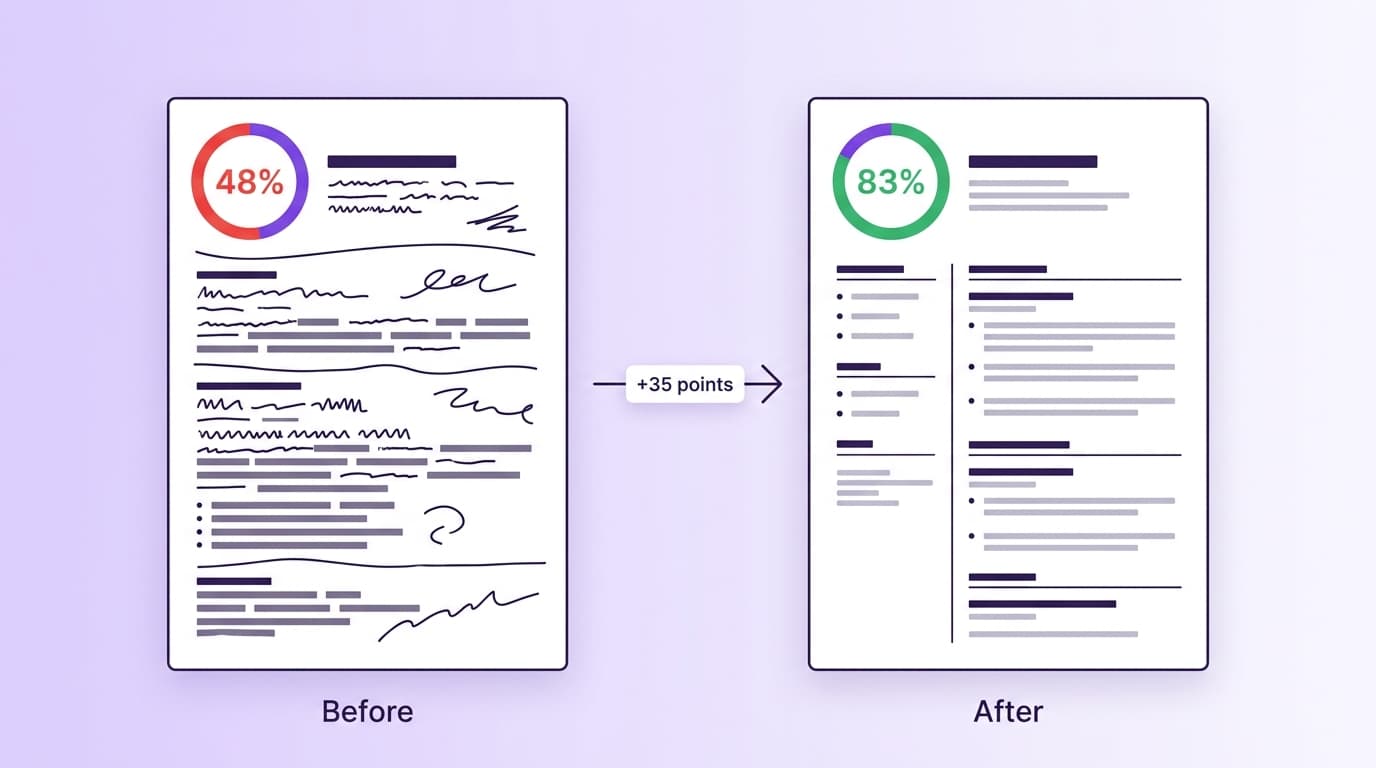
The median CV that first lands in our checker scores 48 out of 100. The same CV after a focused 30 minutes of fixes typically scores 80 or above. The gap is not knowledge, it is structure. Most CVs that score low do so because of a two-column layout, contact info in the wrong place, creative section names and missing keywords from the spec. Each one is a 5 to 25 point swing.
97.8 percent of Fortune 500 companies use an ATS in 2026, per the Jobscan ATS Usage Report. The systems they run (Workday, Greenhouse, Lever, iCIMS, Taleo, SmartRecruiters) each parse CVs slightly differently, but the seven steps below satisfy all of them at once.
Combine this workflow with our free ATS-friendly resume template and ATS resume keywords guide for the deep dives on the two highest-impact steps. When you are done, score the result in our free ATS resume checker.
Total time: about 32 minutes. Steps are ordered by impact, do them in sequence and you compound the score gains.
You cannot optimise what you have not measured. Run your current CV through a free ATS checker before touching anything. The median first-submission score is 48 out of 100. Note the dimensions where it loses points: keyword match, parseability, formatting, contact info, action verbs, quantified achievements. Those are your fix list.
Practical move
Upload your CV to our free checker. Take a screenshot of the score. You will compare against it at the end.
If you are running a two-column template, this is the single highest-impact change. Workday and Taleo read strictly left-to-right, top-to-bottom, scrambling right-column dates and contact info into the bottom of the parsed record or losing them entirely. Greenhouse and Lever scramble about one in five two-column documents.
Practical move
Open the master template from our ATS-friendly resume template and paste your content into a clean single-column structure.
Many parsers skip the document header and footer regions. Name, email and phone in the Word header bar disappear from the record. Move them to the top of page one as plain text.
Practical move
Delete the header bar entirely. Type your name in 18 to 20 point bold at the top, then one plain-text line with city, email, phone and LinkedIn URL.
iCIMS and SmartRecruiters search by section. Rename "My Career Story" to "Experience". Rename "Things I Am Good At" to "Skills". Boring labels are searchable labels. The skills-based filtering trend in 2026 means your Skills block is now weighted higher than ever, so it must be named exactly that.
Open the job spec next to your CV. Mark every skill, tool, certification and responsibility, and every word that appears three or more times. Then mirror that wording in your Skills section and across two or three bullets in Experience. Over 60 percent of companies now filter on skills before reviewing work history, per 2026 recruiter survey data.
Practical move
For the full deep dive on which keywords matter and where they go, see ATS resume keywords.
Recruiter eye-tracking shows the first bullet under each role gets the most attention. Replace "Responsible for managing the team" with "Managed a 6-person engineering team across two product squads, delivering 4 major releases in 12 months." If you cannot honestly add a number, sharpen the verb and the scope.
Practical move
Use a prompt from 25 ChatGPT resume prompts to suggest the rewrite, then drop in your real numbers.
Run the new version through the checker. Confirm the score is above 80. Save as .docx for submission unless the posting specifically asks for PDF. Name the file FirstName_LastName_Position.docx, not resume_v7_final_final.docx.
Practical move
The Jobscan 2023 study found 75 percent of recruiters cite file type as a top factor in passing the initial ATS screen.
Five edits we make on every optimisation pass. Each one is small. Together they account for most of the score lift.
Section heading
Before
My Career Story
After
Experience
Contact line
Before
[Inside Word header bar with profile photo and icons]
After
Jane Doe | London, UK | jane@email.com | +44 7000 000 000 | linkedin.com/in/janedoe
Bullet
Before
Responsible for managing the social media team and growing audience across channels.
After
Led a 6-person social team across Instagram, TikTok and LinkedIn, growing combined audience by 180k in 9 months.
Skills
Before
Python ▮▮▮▮▯ (skill bar)
After
Python (Working knowledge, 4 years commercial)
File name
Before
resume_v7_final_FINAL.pdf
After
Jane_Doe_Marketing_Manager.docx
The free checker shows your starting score and the ranked fixes. Apply the workflow, re-upload, watch the number climb.
Everything we get asked about the workflow, the times, the order, and what to do when the score still will not move.
ATS optimisation
The three CV formats (reverse chronological, functional, hybrid) and how each parses across Workday, Greenhouse and Lever. With section order, file type, file naming, and the format Jobscan recruiters say is the top factor.
ATS optimisation
A plain-English explainer: what ATS stands for, what the parser does with your CV, why 98 percent of Fortune 500 companies use one, and how an ATS resume differs from a regular CV. With the four rules that take you from a regular CV to an ATS-friendly one.
ATS optimisation
Real ATS-friendly CV examples by role: software engineer, marketing manager, finance analyst, nurse, teacher, product manager and more. Each with a parser-tested layout, sample bullets that score, and what to change for your target role.
How applicant tracking systems work, what they extract, and where they cut your CV.
Read articleThe skills that score highest in 2026 and how to phrase them so a parser picks them up.
Read articleWhy typography matters for parsing, and the six fonts that always work.
Read article