01
Assign a role
Start with "You are a senior recruiter for [function] roles at [type of company]". This narrows the response from generic to function-specific. MIT Sloan and OpenAI both list role assignment as the highest-leverage prompt lever.
Twenty-five copy-paste prompts organised by section, built around the four prompt-engineering rules. Plus the AI tells to strip out before you send.
Drop your CV to start
.pdf, .docx or .doc, up to 10 MB
Prefer not to upload yet? See a sample report
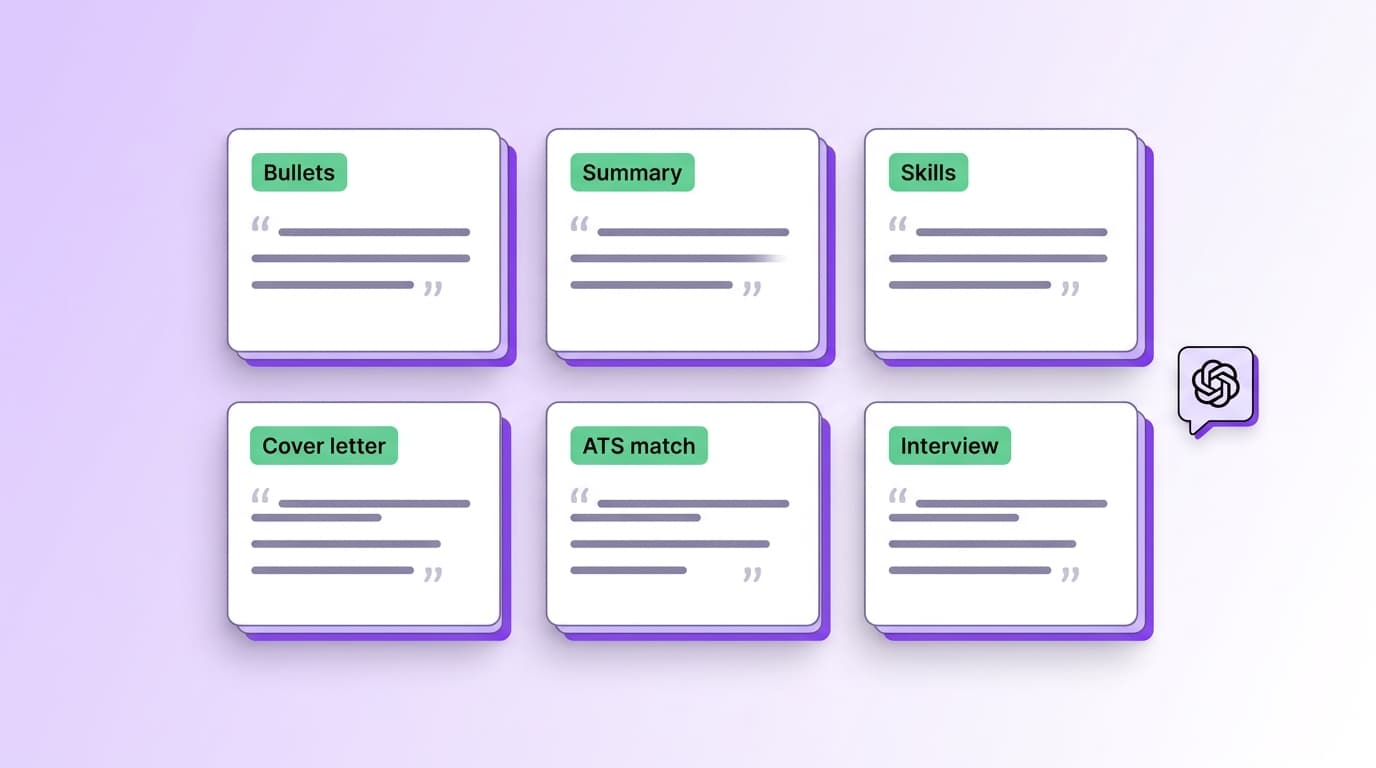
Most people paste their CV into ChatGPT and type "make it better". The result is identical to what ChatGPT gives every other person who did the same thing: "results-driven", "proven track record", "passionate about", three invented metrics, no awareness of your target role.
A 2024 ResumeBuilder survey found that 74 percent of hiring managers can identify AI-generated CVs, and 57 percent said they are less likely to hire candidates whose CVs read as fully AI-written. The fix is not to avoid ChatGPT. It is to prompt it well enough that the output sounds like you, not like everyone.
The four rules below come from MIT Sloan teaching guidance and OpenAI prompt-engineering documentation, adapted for CV use. Every prompt in this page applies all four.
Use all four every time. Skip one and the output drifts back to generic.
Start with "You are a senior recruiter for [function] roles at [type of company]". This narrows the response from generic to function-specific. MIT Sloan and OpenAI both list role assignment as the highest-leverage prompt lever.
Paste your real CV bullet, your target role, the job spec, your seniority. The output quality tracks the input specificity. Vague request, vague answer.
Word count, voice, banned phrases, format. Add "no fluff, no marketing language, no \"passionate\" or \"spearheaded\"" and the output drops 80 percent of the AI tells.
ChatGPT was 73 percent consistent on identical prompts in 2025 testing (Open Access Government). It also invents numbers. Read every line, swap invented metrics for real ones, then run the result through our free ATS checker.
The difference between a generic ChatGPT prompt and a working one is about 60 words of input.
Weak prompt
Make my resume better.
Strong prompt
You are a senior recruiter for product marketing roles at B2B SaaS scaleups. Rewrite the experience section of this CV to mirror the language of the attached job spec, without inventing skills or metrics I did not provide. Use action verbs, under 20 words per bullet, no "passionate" or "spearheaded". For any bullet where I have given you a number, keep it verbatim. For bullets without a number, flag where one should go in square brackets.

CV: "[paste]"

Job spec: "[paste]"
Organised by section. Replace every [bracketed placeholder] with your own context. Paste, run, edit, verify.
The single highest-impact use of ChatGPT for CVs. Best when you paste in the bullet plus what you actually did.
You are a senior recruiter. Rewrite this CV bullet using a strong action verb and a measurable outcome. Keep it under 20 words. No filler, no "passionate", no "spearheaded", no "leveraged". If the original has no metric, flag where one should go in square brackets rather than inventing one.

Original bullet: "[paste your bullet]"

My actual contribution: [one sentence on what you did]
Compress this CV bullet to under 18 words while keeping the action verb, scope and metric. Cut adjectives and adverbs first.

"[paste your bullet]"
You are a senior recruiter for [function] roles. Produce three bullet variants for the same achievement, each leading with a different action verb. Each under 20 words. Include the metric "[your number]" verbatim. No marketing language.

Achievement: [one or two sentences describing what you did and the outcome]
You are a CV reviewer. Diagnose three specific problems with this bullet (verb choice, vagueness, missing metric, wrong scope, AI tells). Suggest one fix per problem. Quote the exact phrases you are critiquing.

Bullet: "[paste your bullet]"
You are a senior recruiter. Rewrite this CV bullet so it uses the language of the attached job spec, mirroring the exact terms it uses for tools, methods and seniority. Do not add anything I did not actually do.

CV bullet: "[paste]"

Job spec: "[paste the relevant section]"
Use ChatGPT for variants, not the final draft. Always edit out the AI tells before you ship.
You are a senior recruiter. Write three professional summary variants for this candidate. Two to three sentences each. Different tone (direct, narrative, results-led). State seniority, function, two specialisms, one quantified outcome. No "passionate", no "results-driven", no "proven track record".

Candidate: [seniority, function, years, two specialisms, one quantified outcome]
Tighten this CV summary by cutting filler words and any phrase a hiring manager has read in a thousand other CVs. Keep the underlying claims. Aim for under 50 words.

Summary: "[paste your summary]"
You are a CV reviewer specialising in career changers. Write a two to three sentence summary for someone moving from [previous function] to [target function] after [number] years. Lead with what transfers, not what is changing. No apologetic language.
Rewrite this CV summary to mirror the language of the attached job spec. Keep my actual experience truthful. Do not invent skills. Do not exceed 60 words.

My summary: "[paste]"

Job spec: "[paste]"
ChatGPT is good at extracting the dictionary of a job spec and grouping skills by category. Keep the proficiency claims to ones you can defend.
Extract every hard skill, tool, method and certification from this job spec. Return them as a comma-separated list, deduplicated. Do not paraphrase. Use the exact wording from the spec.

Job spec: "[paste]"
Group this list of skills into three categories: Languages, Tools, Methods. Order each category by relevance to a [target role]. Drop anything that does not fit a CV skills section.

Skills: [comma-separated list]
For each soft skill in this list, replace it with a specific behaviour I have demonstrated. Use first-person past tense. Example: "team player" becomes "facilitated weekly cross-team standups for 8 engineers". I will provide a behaviour for each.

Soft skills: [list]
ChatGPT produces a decent skeleton when you give it your CV plus the job spec. The opener and the why-this-company sections need your specifics.
You are a senior recruiter. Draft a four-paragraph cover letter for this role based on the candidate's CV and the job spec. Specific opener (no "I am writing to apply"), one paragraph on relevant experience, one paragraph on why this company, sign off with a clear next step. Under 300 words. British English.

CV: "[paste]"

Job spec: "[paste]"

Company: [name and one factual detail you found about them]
Give me three distinct opening lines for a cover letter for this role. Each must include a verb in the first three words, name the company, and reference something specific to the role (not a generic claim).

Role: [title and company]

Why I am applying: [one sentence in your own words]
Write a 60-word paragraph on why I am a fit for this company specifically. Reference [recent fact or initiative you have actually researched]. Avoid mission-statement language. Do not invent claims I cannot defend.
Write a 50-word paragraph that explains a [number] month break for [reason] without apology. Frame what I learned or built during it. Tone: matter-of-fact, professional.
ChatGPT can compare your CV to a spec word-for-word. It cannot tell you whether the CV will parse cleanly in Workday or Lever. For that, use our ATS resume checker.
Compare this CV against this job spec. List every important skill, tool or method the spec mentions that does not appear in my CV. For each, suggest the most truthful place I could add it. Do not invent skills I do not have.

CV: "[paste]"

Job spec: "[paste]"
I need to add the keyword "[term]" to my CV in a way that does not look like stuffing. Show me three places where it could legitimately appear, based on this experience block.

Experience block: "[paste relevant bullets]"
Compare these two CV versions side by side for [target role]. List what improved, what got weaker, and what got vaguer. Pick a winner and justify it in two sentences.

Version A: "[paste]"

Version B: "[paste]"
Read this CV. Identify every formatting decision that could cause ATS parsing problems in Workday, Greenhouse or Lever (tables, columns, headers, icons, skill bars, unusual section names). Be specific: quote the section and the issue.

CV: "[paste]"
For each role in this CV, suggest a standardised job title that recruiters search for, matched to industry conventions. Keep the original in brackets if it differs significantly. Do not inflate seniority.

Roles: [paste each role and title]
A CV that gets you the interview is half the battle. Use these for the second half.
You are a hiring manager for [role] at [company]. Based on this CV and job spec, generate the 10 questions you would most likely ask in a 45 minute first-round interview. Split into: behavioural, technical, role-specific.

CV: "[paste]"

Job spec: "[paste]"
Help me build a STAR answer for the question "[paste question]". I want short prompts for Situation, Task, Action and Result, not a finished script. Ask me one clarifying question per section before writing the next.
Write a 90-second "tell me about yourself" for this specific role. Three beats: who I am professionally, the strongest evidence I am right for this role, why this company specifically. No marketing language, no "passionate", no "results-driven".

My CV: "[paste]"

The role: "[title, company, one factual detail]"
Write a 100-word email negotiating an offer of [amount] for a [role] at [company]. Reference [market comparable or competing offer]. Direct, professional, leaves the door open. British English. No "I would love to" or "I just wanted to".
ChatGPT can polish copy but not check parsing. Drop the edited CV into the free checker for the score and the fix list.
Everything we get asked about ChatGPT prompts for CVs, what to remove, and how to combine ChatGPT with proper ATS tooling.
AI resume tools
A six-step workflow for using ChatGPT to write a resume that does not look AI-written. With section-by-section prompts, verification rules, and the ATS check at the end.
AI resume tools
A direct answer with 2026 data: what happens when you let ChatGPT write your CV from scratch, what 78 percent of users got right, where the 49 percent auto-dismiss rate comes from, and the workflow that protects you.
AI resume tools
The broad guide. 51 percent of job seekers used ChatGPT to write their CV in 2026. Here is what works, what fails, the four ways to use it, and links to deeper material on prompts, workflow, and ATS scoring.
Professional summaries by seniority, with templates and the words that actually pull recruiter attention.
Read articleHow to introduce yourself in a job interview, with examples by seniority and function.
Read articleThe skills that score highest in 2026 and how to phrase them so an ATS picks them up.
Read article