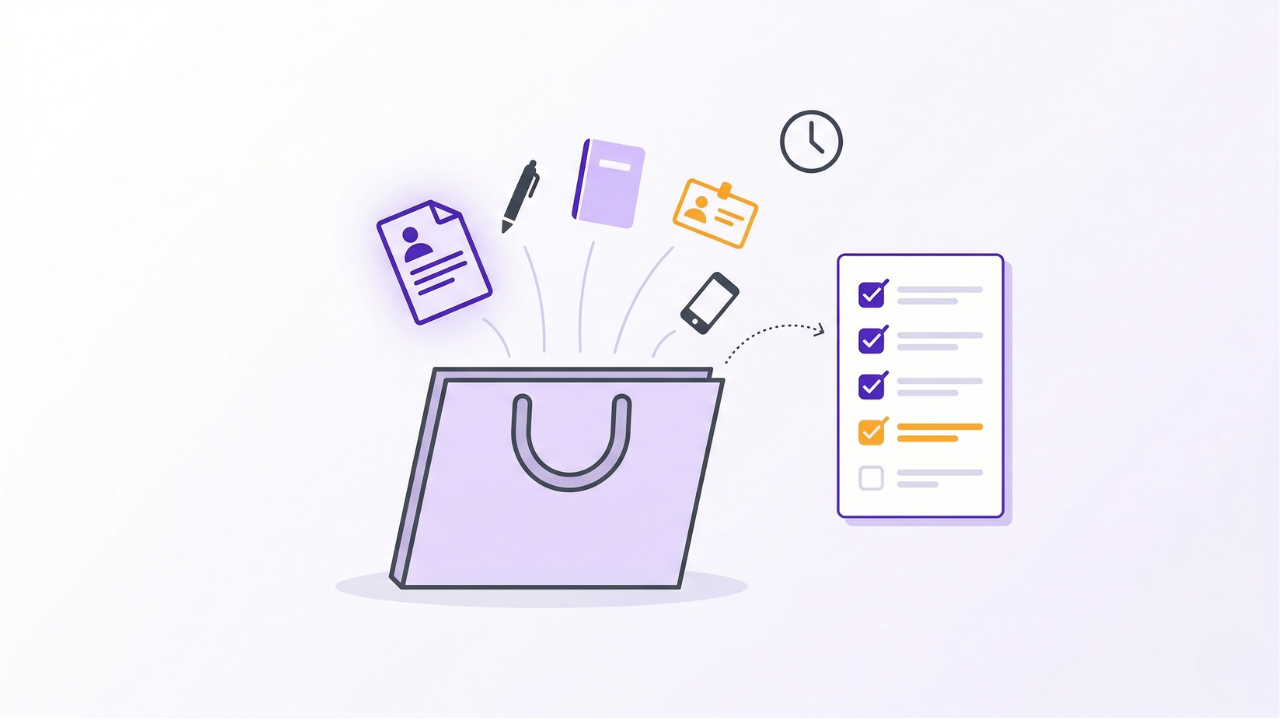
Showing up unprepared is the easiest way to tank an interview you are otherwise qualified for. The good news is that interview preparation is largely about logistics. A clear checklist, followed carefully, means you walk in with nothing on your mind except the actual interview.
This guide covers the full interview checklist for in-person, phone, and video interviews, plus a day-before preparation timeline you can follow to arrive calm and ready.
The Essential Documents Checklist
These are the non-negotiables. If you forget these, you start on the back foot.
1. Multiple copies of your CV
Bring 5 to 6 printed copies on professional-quality paper. You may meet multiple interviewers, and not all of them will have a printed copy in front of them.
If you are unsure whether your CV is at interview standard, see our guides on:
2. A reference sheet (on request)
Do not hand this over unsolicited. Keep it with you so you can provide it if asked. See our guide on references on your CV for how to format it.
3. A printed copy of the job description
Highlight the requirements you are strongest on. This gives you a reference if the conversation drifts from the core role.
4. A list of prepared questions
3 to 5 thoughtful questions for the interviewer. Avoid asking about things easily found on the website.
5. Photo ID
Many corporate offices require ID at reception. Bring your passport, driving licence, or national ID.
6. Your portfolio (if relevant)
For creative, technical, or product roles, a curated portfolio of 3 to 5 work samples is powerful. Print a summary page with links to the full items if they are online.
7. Relevant certifications or licences
If the role requires specific certifications (e.g., teaching, medical, construction), bring originals or certified copies.
How Many Copies of Your CV Should You Bring?
The rule of thumb is one copy per interviewer, plus two spares.
- Solo interview: 3 copies
- Panel of 3 to 4: 5 to 6 copies
- Final-stage multi-round: 6 to 8 copies
Paper quality matters
Use 80 to 100 gsm paper, not standard printer paper. Light cream or bright white both work. Avoid coloured paper, textured paper, or anything with watermarks. The goal is professionalism, not decoration.
Portfolio and Work Samples
Bring these if you are applying for any role where your output can be shown, not just described.
Creative roles
3 to 5 recent pieces showing range. Include:
- The final deliverable
- A short explanation of the brief
- The outcome (if available)
Technical roles
- 1 or 2 code samples or architecture diagrams
- Links to your GitHub or technical blog
- Outcome-focused case studies
Analytical and data roles
- A 1-page sheet of your best data visualisations
- A before-and-after example of a dashboard or report you built
Marketing and sales roles
- Campaign examples with metrics
- Case studies showing revenue or conversion impact
For profession-specific guidance, see our guides on:
5 Smart Questions to Bring for the Interviewer
Prepare these in writing. Some are role-specific, but these 5 work for almost any interview.
1. "What does success look like in this role in the first 6 months?"
Reveals expectations and helps you assess whether the scope matches your skills.
2. "What are the biggest challenges facing the team right now?"
Shows you think about problems, not just opportunities. Their answer also tells you a lot about what is really going on.
3. "How does this role interact with other teams in the company?"
Helps you understand the dependencies and cross-functional dynamics. Important for almost every modern role.
4. "What do you enjoy most about working here?"
Humanises the conversation and gets you an authentic answer about culture.
5. "What are the next steps in the process?"
Always end with this. It signals interest and helps you plan your follow-up.
Technology and Practical Items
Phone (charged)
Silence it or set to do-not-disturb before you walk in. Do not pull it out during the interview, even between rounds.
Directions and backup directions
Screenshot the route in case your signal drops. Know which floor, which reception, and which contact person you should ask for.
Travel time buffer
Plan to arrive 15 minutes before the interview. Enter the building 10 minutes before. Too early makes you look anxious; too late obviously looks bad.
Water bottle
Carry one in your bag. Dry mouth is a real problem in nervous situations.
Notepad and pen
Take handwritten notes during the interview. It shows engagement and gives you something to hold, which helps with nerves.
Folder or portfolio case
A slim A4 folder to hold your CVs, job description, and notes. This is far better than loose papers.
Small emergency kit
- Tissues
- Stain remover pen
- Lint roller (especially for darker clothing)
- Breath mints (never gum)
- Plasters for new shoes
What NOT to Bring
Your laptop
Unless specifically requested, leave it at home. It creates awkwardness and signals you are not fully focused on the conversation.
Coffee or food
Never bring food or a takeaway cup into the interview room. Drink your coffee outside, then go in.
Expensive or flashy accessories
This depends on the industry. In finance, a good watch is fine; in non-profit, it can create the wrong impression. Dress and accessorise for the company, not for yourself.
Uninvited plus-ones
Never bring a friend, partner, or parent to the interview location.
Your phone visible on the table
If it is in your pocket or bag, it is not a problem. On the table, it is a signal of divided attention.
Anything you cannot explain
If you bring a portfolio, you should know every piece of it cold. If you bring certificates, they should be relevant. Props that you cannot discuss are worse than no props.
Virtual Interview Checklist
If your interview is over video, the preparation list shifts.
Technical setup
- Internet connection: Test via speedtest.net. Aim for at least 20 Mbps upload.
- Backup internet: Know how to hotspot from your phone in case Wi-Fi fails.
- Platform: Download and test Zoom, Teams, or whichever tool is specified.
- Camera: At eye level, not below. If your laptop camera is too low, stack books underneath.
- Microphone: Ideally wired headphones with a mic. Built-in laptop mics pick up echo.
- Lighting: Natural light from in front, not behind. If no natural light, a desk lamp facing you works.
Your space
- Private room, door closed
- Neutral background (or a subtle virtual one if your real background is distracting)
- Tell anyone else in your home the timing so they do not interrupt
- Put pets in another room
- Silence your phone and close all notifications on your computer
On-screen materials
Have these open on your screen or next to you:
- Your CV (on paper, not on screen, so you can glance down naturally)
- The job description
- Notes on the company
- Your prepared questions
Dress code
Dress as you would for the in-person equivalent. Full outfit, not just shirt on top. Standing up mid-call happens, and pyjama bottoms will end the interview fast.
Test run
Do a 10-minute test call with a friend on the same platform the day before. Check audio, video, screen share, and chat.
The Day-Before Preparation Timeline
The night before
- Lay out your outfit (fully, including shoes and accessories)
- Pack your folder with CVs, job description, questions, and ID
- Charge your phone and ensure directions are saved
- Review your prepared answers for common questions (why should we hire you, why do you want to work here, describe yourself, strengths and weaknesses)
- Re-read the job description
- Eat dinner and sleep at your normal time
The morning of
- Eat a proper breakfast
- Leave with 30 minutes of buffer for travel
- Re-read your CV one last time
- Re-read the company's "About" page
- Arrive 15 minutes early, enter reception 10 minutes before
5 minutes before
- Check appearance in a mirror
- Silence your phone
- Take 3 deep breaths
- Walk in
Post-Interview Follow-Up
Within 24 hours, send a thank-you email to each interviewer.
The email structure:
- Thank them for their time
- Mention something specific from the conversation
- Briefly reinforce one reason you are a fit
- Close with openness to next steps
Example:
Subject: Thank you (role) interview
Hi (Name),
Thank you for taking the time to speak with me today. Your description of the challenges around the (specific topic discussed) was particularly useful, and it reinforced why this role feels like a strong fit.
As we discussed, my work at (previous company) involved a similar problem, and I would be keen to share more about how we solved it if that would be helpful in the next round.
Thank you again, and I look forward to hearing about next steps.
Best,
(Your name)
For more on professional email structure, see our email when sending CV guide.
Frequently Asked Questions
Should I bring a cover letter to the interview?
Only if the role required one in the application. If so, bring a copy in case the interviewer did not see yours. For cover letter guidance, see our motivation letter guide.
Is it okay to take notes during the interview?
Yes. Taking brief notes shows engagement. Do not transcribe everything, but jot down names, key points, and questions you want to follow up on. Keep your notepad on your lap or beside you, not blocking your chest.
What if I forget something?
If it is minor (like forgetting to bring a pen), ask to borrow one with a smile. If it is major (you forgot your CV), apologise briefly and offer to email it immediately afterwards. Do not let a small logistical issue derail your focus.
Should I bring a gift for the interviewer?
No. Gifts are inappropriate and can read as a bribe. Send a thank-you email after the interview instead.
What if the interview is at a coffee shop?
Bring your essentials: CV copies, notepad, pen, ID, and your prepared questions. Arrive first and pick a quiet table. Order a simple drink you can easily set aside (not a messy one). Offer to pay for yours, but let them decide.
How early should I arrive?
Aim to be within walking distance 15 minutes before, and enter the building 10 minutes before. Arriving more than 15 minutes early can put pressure on the interviewer to start before they are ready.
Key Takeaways
- Bring 5 to 6 printed CV copies on quality paper
- Always bring: CVs, job description, prepared questions, notepad and pen, photo ID, folder, water
- Prepare 3 to 5 thoughtful questions in writing
- For virtual interviews, test your tech 24 hours in advance and have a backup plan
- Never bring: your laptop (unless requested), food or coffee, your phone visible on the table, uninvited plus-ones
- Follow up with a thank-you email within 24 hours
- Pair this logistical prep with your answer prep for common questions