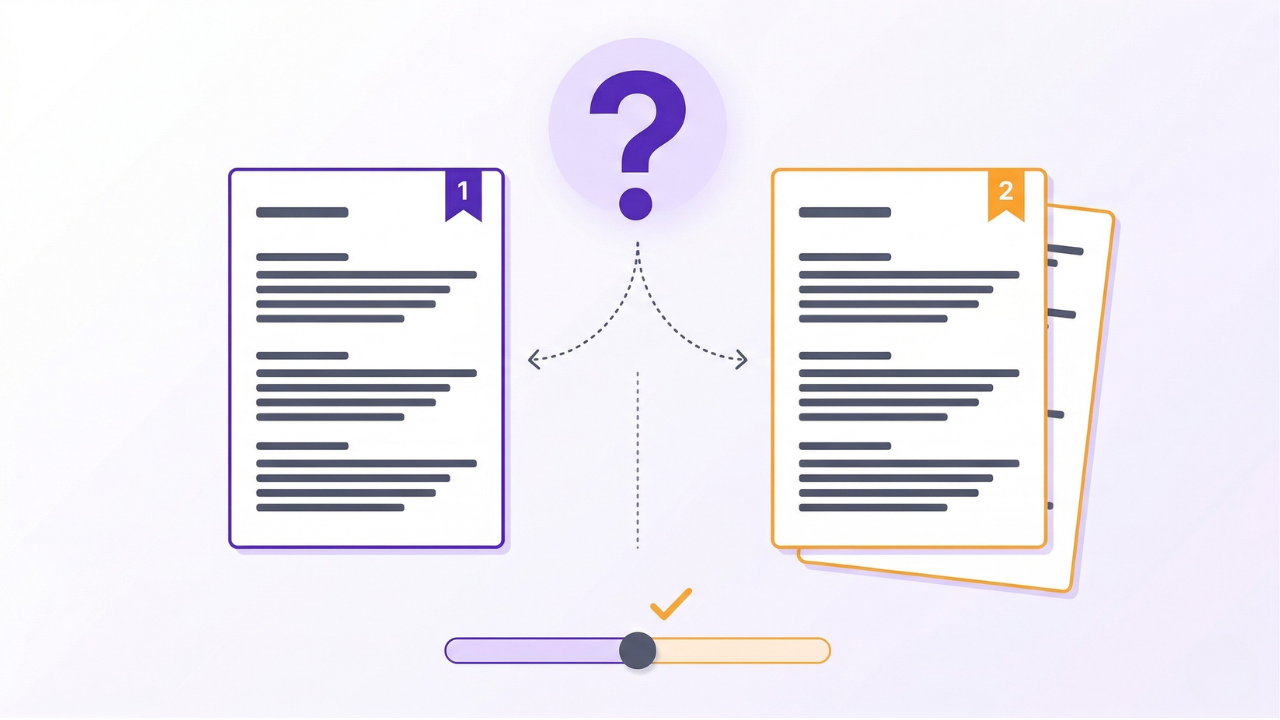
The "one page only" rule has dominated CV advice for decades. In 2026, that rule is largely out of date. A recent recruiter survey found that 68.6% now prefer two-page CVs, with only 21.6% still favouring one-page documents. Recruiters were 2.3 times more likely to rate two-page CVs favourably than one-page ones.
So should your CV be one page or two? The answer depends on your experience level, industry, and the role you are applying for. This guide walks through exactly when each length works best, how far back your work history should go, and practical tips for trimming or expanding your CV.
The Short Answer
- Freshers, graduates, and early-career professionals (0-5 years): One page
- Mid-career professionals (5-10 years): One or two pages
- Senior professionals and executives (10+ years): Two pages
- Academic, medical, and federal CVs: No fixed limit
The key is relevance, not rigidity. A tight, well-edited one-page CV always beats a bloated two-page CV padded with filler. And a focused two-page CV always beats a cramped one-page CV with 8-point font and no white space.
When a One-Page CV Is the Right Choice
A single page works best when you genuinely do not have enough relevant content to justify more. Use one page if:
You have less than 5 years of relevant experience
Graduate schemes, first jobs, and early-career roles rarely need more than one page. Your education, early work, and key skills fit comfortably in a single page without looking thin.
See our student CV guide for help filling one page when you are starting out.
You are applying to a role that specifically asks for one page
Some industries (particularly consulting, investment banking, and certain US employers) explicitly request one-page CVs. Follow the instruction. Ignoring it signals that you cannot follow directions.
You are changing industries or careers
When your past experience does not obviously match your target role, a shorter CV forces you to focus on transferable skills rather than irrelevant details. Pair it with a strong resume objective that bridges the gap.
Your strongest material fits on one page
If your 3 most impressive achievements, 2 most relevant roles, and 1 degree comfortably fit within a single page at 10-12 point font, there is no reason to pad.
When a Two-Page CV Is Acceptable (or Expected)
Two pages is the default for most professional roles in 2026. Use two pages if:
You have 10+ years of relevant experience
Compressing a decade of work onto one page forces you to cut meaningful achievements. A second page gives you room to show your progression, key results, and technical depth.
You are applying for senior, managerial, or executive roles
At this level, recruiters expect breadth and depth. A two-page CV allows you to show strategic contributions, team leadership, budget responsibility, and cross-functional work without cutting corners.
You have multiple relevant skills, certifications, or qualifications
Technical professionals (engineers, data scientists, healthcare specialists) often have skills sections, certifications, and project work that do not fit on one page. Cramming them looks worse than giving them space.
Your industry expects detailed CVs
Academic, medical, legal, and federal government CVs routinely run to 3 or more pages. The one-page rule does not apply to these fields.
For profession-specific guidance, see our:
How Far Back Should Your CV Go?
Here is the general rule: 10 to 15 years of work history. Anything older is usually irrelevant and risks introducing age-related bias into the screening process.
By career stage:
What to do with older experience
If you have highly relevant experience from more than 15 years ago, you have a few options:
- Add a "Career Highlights" section at the top of your CV summarising older wins in bullet points
- Create an "Earlier Experience" section listing older roles with job titles and dates only (no duties)
- Mention older achievements in your CV summary to signal depth without listing every role
When Going Over One Page Is a Bad Idea
A two-page CV can work against you if the second page is weak. Specifically, avoid spilling over onto page two if:
- Your second page is less than half full. A half-empty page looks lazy and unfinished. Either trim the content to fit one page or expand the second page with more relevant detail.
- The content on page two is mostly filler. If page two is padded with irrelevant early jobs, obvious skills, and generic hobbies, it adds nothing. Cut it.
- Your strongest achievements are buried on page two. Recruiters spend more time on page one. Lead with your best content, not your oldest.
- You are a fresher or early-career candidate. Two pages from someone with 2 years of experience signals inflation or lack of judgement.
How to Trim Your CV to One Page
Struggling to fit everything on one page? Try these cuts before adjusting margins or fonts:
Cut generic hobbies and interests
Unless your hobbies directly relate to the role, this section is the first to go. For guidance on what to keep, see our hobbies on CV guide.
Remove jobs older than 10-15 years
Irrelevant, outdated roles rarely help and often hurt.
Condense bullet points
Each job should have 3 to 5 bullet points, not 8 to 10. Pick your strongest achievements and cut the rest.
Trim your skills section
Include only skills that match the job description. A focused list of 8-12 skills beats a sprawling list of 25.
Shorten your CV summary
If your summary is over 80 words, cut it down. Every sentence must carry weight.
Only adjust formatting as a last resort
Reducing font size below 10 points or shrinking margins below 0.5 inches makes your CV hard to read. If you are relying on typography tricks to fit one page, it is probably time to go to two.
How to Expand Your CV to Two Pages
Going from one page to two is not about padding. It is about adding relevant detail. Consider:
Quantify more of your work experience
Turn every bullet point into an achievement with metrics. "Managed social media" becomes "Grew LinkedIn following from 3K to 28K in 18 months." This adds depth without adding empty words.
Add a dedicated skills section
A well-organised skills section can legitimately take 4 to 6 lines, especially for technical roles.
Include a certifications section
If you have multiple relevant certifications, give them their own section rather than burying them in education.
Add a projects or portfolio section
Personal projects, freelance work, and open-source contributions are highly valued in tech, design, and creative roles.
List relevant publications, talks, or awards
Especially useful for senior, academic, and research-focused roles.
ATS and CV Length: What You Need to Know
Most applicant tracking systems do not care whether your CV is one or two pages. They parse the content, not the page count. What matters for ATS compatibility:
- Use a clean, single-column layout (multi-column CVs confuse many ATS parsers)
- Use standard section headings like "Experience," "Education," and "Skills"
- Submit as a .docx or .pdf file, depending on the employer's preference
- Avoid images, icons, and text boxes in critical content areas
For more on formatting, see our best font for CV guide.
Frequently Asked Questions
Is a one-page CV still acceptable in 2026?
Yes. One page is ideal for freshers, graduates, and early-career professionals with less than 5 years of experience. It is also the default in certain industries like consulting and investment banking. The key is whether your strongest content fits on one page without cramming.
Can a CV be 3 pages long?
For standard professional roles, three pages is generally too long. The exceptions are academic CVs (where publications and research alone can fill several pages), medical CVs, and federal or executive CVs with extensive histories. If you are not in one of these fields, aim for two pages maximum.
How far back should my CV go?
For most roles, 10 to 15 years. Older experience is typically irrelevant and risks introducing bias. If pre-15-year experience genuinely matters (for example, you were an early engineer at a company you are applying to), mention it in your CV summary or in a brief "Career Highlights" section.
Should I include every job I have ever had?
No. Include jobs relevant to the role you are applying for. Short gigs, unrelated early jobs, and positions from over 15 years ago usually add noise rather than value. Exception: if your CV has gaps or limited experience, including short-term roles with clear relevance can help.
What if my CV is 1.5 pages long?
This is the worst length. Either commit to one page (by trimming) or commit to two (by adding meaningful detail). A half-empty second page looks unfinished and lazy.
Does the CV length rule change if I am applying internationally?
Yes. In the US, one-page resumes are more common for junior and mid-level roles. In the UK, Europe, and parts of Asia, two-page CVs are the norm. Academic CVs can run much longer globally. Always check the employer's stated preference if available. For a country-specific example, see our Canadian resume format guide.
Key Takeaways
- In 2026, 68.6% of recruiters prefer two-page CVs over one-page CVs
- Use one page if you have less than 5 years of experience or the employer specifies one page
- Use two pages for most professional roles, especially with 10+ years of experience
- Limit work history to the past 10-15 years in most cases
- Avoid 1.5-page CVs: either fit on one page or fill two
- Length matters less than content quality: a focused 2-page CV beats a padded 1-page CV
- ATS systems parse content, not page count, so formatting matters more than length