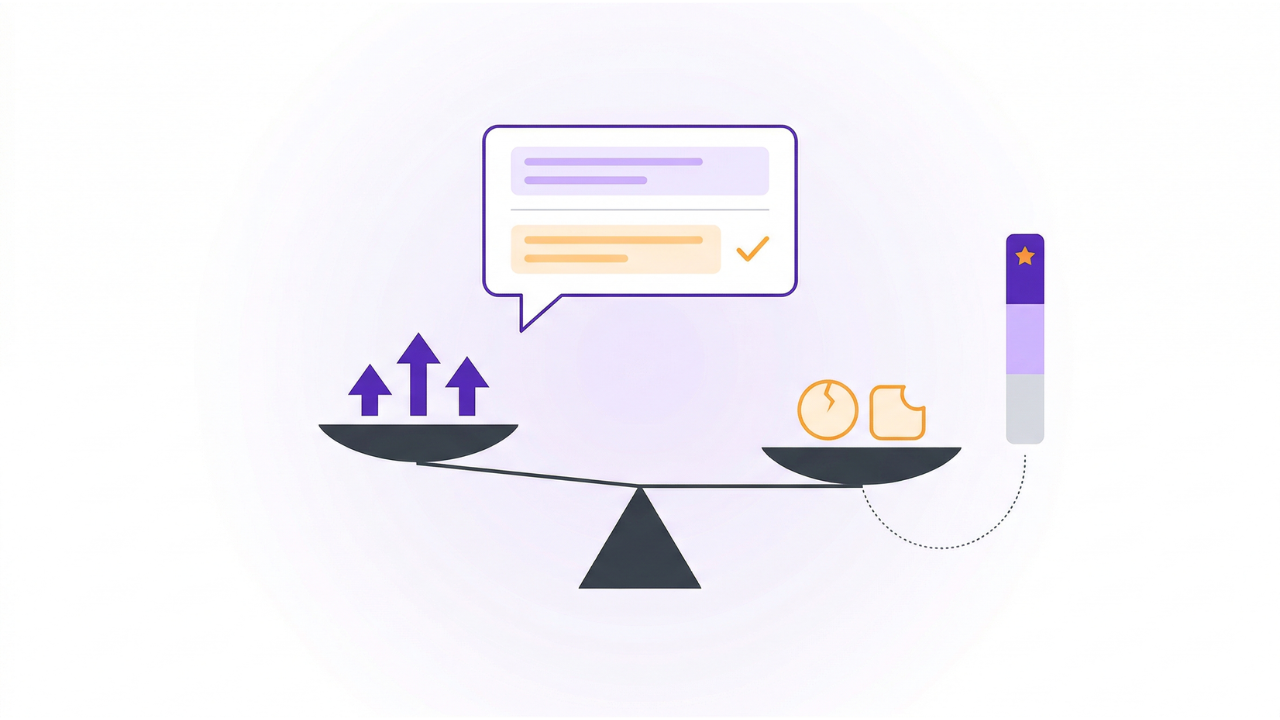
"What are your strengths and weaknesses?" sounds simple but trips up most candidates. The strengths half is easy to oversell. The weaknesses half is a minefield: too real and you sabotage yourself, too fake and you sound rehearsed.
The fix is self-awareness paired with evidence. Real strengths backed by numbers. Real weaknesses paired with a concrete improvement plan. This guide covers exactly how to answer both questions, with 30+ examples you can adapt.
Why Interviewers Ask This
The strengths question checks whether you can articulate what you are good at and whether those strengths match the role. The weakness question tests something harder: self-awareness, honesty, and your willingness to grow.
Hiring managers are not looking for perfection. They are looking for:
- Genuine self-awareness (can you name real areas for improvement?)
- Accountability (do you own your weaknesses or blame others?)
- Growth mindset (are you actively working on your weaknesses?)
- Relevance (are your strengths actually useful for this role?)
The Formula for Your Strengths Answer
Step 1: Pick a strength that matches the role
Read the job description. Identify the top 3 required skills. Choose a strength that overlaps with at least one of them.
Step 2: Back it with a quantified example
Every strength needs evidence. A number, a specific project, or a measurable outcome.
Step 3: Tie it to the role
Close with how this strength will help you succeed in the role you are applying for.
15 Strengths with Interview Scripts
1. Adaptability
"One of my strengths is adaptability. In my last role, our product pivoted from mid-market to enterprise in 6 months. I rebuilt our entire demand generation playbook from scratch, which required learning account-based marketing from the ground up. The new programme generated 60% of the pipeline for Q4. I see adaptability as especially relevant here given the product changes you mentioned in our first conversation."
2. Problem-solving
"I am strongest when solving ambiguous problems. When our engineering team faced a legacy system that was blocking 3 major roadmap items, I was asked to lead the rewrite. I mapped dependencies, split the work into 4 milestones, and coordinated with 3 teams to deliver the migration in 5 months with zero production incidents."
3. Communication
"My core strength is translating complex topics for different audiences. As a senior analyst, I rewrote our quarterly reporting deck so it could be understood by non-finance executives. The CFO specifically flagged it as the clearest board pack the company had produced, and the structure was adopted across all quarterly reviews."
4. Leadership
"I am a strong people manager. In my current role, 3 of the 5 direct reports I have hired and developed have been promoted within 18 months. I run structured monthly 1:1s, set clear development goals, and ask for feedback on my own management each quarter. That habit alone has surfaced issues I would otherwise have missed."
5. Attention to detail
"Attention to detail is a strength I lean into. When I took over our monthly close at my current firm, I found 14 reconciliation errors in the previous 6 months that had been missed. I introduced a review checklist that has held error rates below 1% every month since. I would bring that same rigour to your audit engagements."
6. Technical depth
"Deep technical expertise in cloud architecture is my main strength. I have led 3 full AWS migrations, each with measurable cost savings between 30% and 45%. Last year I was asked to lead an internal training programme on infrastructure as code, which now runs quarterly and has trained 40+ engineers across the company."
7. Empathy and client focus
"My strength is building long-term trust with clients. In my last account, I inherited a relationship that had seen 3 account managers in 2 years and was close to churning. By shifting from monthly check-ins to structured quarterly business reviews and setting clearer success metrics, I not only retained the account but expanded it by 40% within a year."
8. Learning velocity
"I learn domains quickly. When I joined my current company, I had no background in insurance. Within 6 months I was running the pricing team. I have a structured approach: shadow 3 practitioners, read the top 10 industry papers, and produce a summary document in my first 30 days. I would use the same approach to ramp up here."
9. Prioritisation
"My strength is ruthless prioritisation. My team regularly gets more requests than we can deliver, and I have built a scoring framework that helps us say no confidently. Last quarter, we completed 90% of our roadmap with 60% of the originally budgeted headcount, because we stopped doing work that was not going to move the metric."
10. Teamwork
"What I am best at is building cross-functional collaboration. At my current company, I run a fortnightly stand-up across marketing, sales, and product that replaced a previously fractured process. The stand-up has since become the key forum for launch planning and has cut average launch prep time by 3 weeks."
11. Creativity
"Creative problem-solving is a strength. When our marketing budget was cut by 40%, I proposed replacing paid advertising with a podcast interview series. It cost 20% of the equivalent paid spend and generated 20% of our annual leads. I enjoy finding unusual angles others have not considered."
12. Reliability
"I am consistently reliable. Across 4 years at my current company, I have never missed a deadline on a committed deliverable. When timelines are at risk, I flag early, renegotiate, and deliver a revised plan rather than letting it slip silently. My manager specifically cites this in our performance reviews."
13. Mentoring
"Mentoring is where I add most value beyond my individual output. I have formally mentored 6 junior engineers, 4 of whom have been promoted during my time at the company. Two have since said publicly that they credit the promotion to the mentorship relationship, which I value more than my own promotions."
14. Strategic thinking
"Strategic thinking is my strongest suit. I am the person my manager turns to when a decision has second-order effects. Last year I spotted that our pricing change would impact our partner channel in ways the exec team had not modelled, which saved us from a 15% revenue hit in the partner segment."
15. Resilience
"I am resilient under pressure. In 2024, my team lost 2 members in the same month ahead of a major product launch. Rather than pushing the launch, I picked up the extra scope personally, hired 2 replacements in 6 weeks, and we still shipped on time with no rollback."
The Formula for Your Weakness Answer
The strongest weakness answers follow a 3-part structure:
Part 1: Name the weakness directly
Pick a real weakness. Not a fake "I work too hard" variant. The weakness should be genuine but not a deal-breaker for the role.
Part 2: Give an honest example
Share a moment when this weakness affected your work or created a problem. This shows self-awareness, not just self-criticism.
Part 3: Explain what you are doing about it
Finish with the specific actions you are taking to improve. This shows growth mindset and self-leadership.
Good weaknesses to mention:
- Tendency to over-explain or over-prepare
- Difficulty delegating
- Public speaking nerves
- Impatience with slow processes
- Tendency to take on too much
- Discomfort with small talk in client settings
- Struggling to say no to requests
- Over-reliance on written communication
Weaknesses to avoid:
- Anything core to the role (e.g., "I am bad with deadlines" for a project manager)
- Character flaws (e.g., "I struggle to tell the truth")
- Fake weaknesses disguised as strengths ("I work too hard")
- Weaknesses with no improvement plan
15 Weakness Answer Examples
Example 1: Over-explaining
"I tend to over-explain. In meetings, I would give the full context when a headline answer was what people wanted. I have been practising a 'headline first' approach: state the conclusion, then provide details only if asked. My recent performance review specifically flagged improvements in how I run stand-ups."
Example 2: Difficulty delegating
"I struggle to delegate. I was promoted to team lead 18 months ago and initially tried to keep hands-on across everything my team delivered. That worked for 3 months, then I hit burnout. I have since introduced a 'stretch project' system where each direct report owns one piece outside their normal remit, which has both developed them and freed up my time."
Example 3: Public speaking nerves
"Public speaking used to make me genuinely anxious. I would avoid presenting whenever I could, even when it was my own work. Last year I joined Toastmasters and committed to presenting at our company all-hands once a quarter. I still get nervous, but I now deliver without it affecting the quality of the content. The last presentation I gave was the most watched company-wide video of the quarter."
Example 4: Impatience with slow processes
"I am impatient with slow processes. When I started at my current company, the monthly close took 12 days and I found that frustrating. That impatience pushed me to propose an automation project, which took the close down to 5 days. But I have learned I need to balance the drive to improve with respect for the people whose processes I am changing. I now start every improvement project by asking 'what would make this easier for you?' to the current process owner."
Example 5: Taking on too much
"I have a tendency to say yes to too much. At the start of last year, I was on 4 committees alongside my delivery work, and something had to give. My director had to step in to help me prioritise. I have since introduced a rule: no new commitment without dropping an existing one, unless my manager approves it. It has helped me be more deliberate and honest about my capacity."
Example 6: Difficulty asking for help
"My weakness is that I sometimes keep pushing on a problem when I should ask for help. Earlier this year I spent a full week debugging a production issue before finally asking a senior engineer, who spotted it in 20 minutes. Since then I have set a 2-hour rule: if I am stuck for 2 hours on something, I post in our team channel before continuing alone. My time-to-resolution has dropped noticeably."
Example 7: Weak on small talk
"I am not naturally strong at small talk, which matters in client-facing roles. I used to skip the warm-up and dive straight into the work. After a client mentioned it in feedback, I started preparing 2 or 3 personal topics in advance for every client meeting, based on what I know about the person. It is still not my natural mode, but clients have commented that recent meetings have felt warmer."
Example 8: Perfectionism (done properly)
"I have a tendency to polish work longer than I should. For a marketing campaign last year, I spent 2 extra days refining copy that was already fine, which delayed our launch. Since then I use a 'good enough to ship' checklist with my manager, which has become the forcing function that stops me from over-refining."
Example 9: Over-reliance on data
"I over-rely on data, especially early in a decision. I sometimes keep pulling reports when a quick call with a customer would give me the answer faster. I have been deliberately practising running customer interviews before I pull any data. On a recent positioning project, 6 calls in a week gave us a sharper insight than 3 weeks of survey analysis."
Example 10: Conflict avoidance
"I am naturally conflict-avoidant and historically have held back feedback longer than I should. I asked my manager to role-play difficult conversations with me monthly, and now I practise giving direct feedback in the moment rather than storing it up. A recent 360 review specifically called out that my feedback has become more useful."
Example 11: Weak at networking
"Networking does not come naturally to me. I can run a technical discussion all day, but cocktail-style events drain me. I have started attending one external event per month and giving myself a goal: meaningful conversations with 3 people, then leave. That small goal has made networking manageable and productive."
Example 12: Struggling with ambiguity
"When I started managing my own projects, I struggled with ambiguous briefs. I was used to being given clear inputs and waited too long to push back when the brief was unclear. I now run a 24-hour 'ambiguity check': within a day of getting a new brief, I write up my interpretation and share it with the requester. It has saved multiple rounds of misalignment."
Example 13: Over-reliance on written communication
"I default to writing over calling. For simple issues, that is efficient. For complex or emotional topics, it can create misunderstandings. I now have a rule: if a message passes 3 back-and-forth replies, I jump on a 10-minute call. It has cut resolution times noticeably."
Example 14: Struggling to disconnect from work
"I have historically struggled to disconnect from work on evenings and weekends. Over time that affected my energy and decision quality. I now have a hard stop at 7pm and a no-laptop-on-Sunday rule. My manager has noticed I am more focused during work hours, which matters more than being always on."
Example 15: New to people management
"Until 12 months ago, I had never managed people. I am still building that skill. I take a course every quarter on a specific aspect of management, I have a peer mentoring group of 4 first-time managers, and I have a monthly session with an external coach. I am comfortable saying this is a skill I am learning, not one I have mastered."
How to Present Strengths on Your CV
Your CV version of this question is different from the interview version. On your CV, include your strengths through:
- A specific CV summary that highlights your top 3 strengths in context
- A skills section that lists concrete abilities
- Achievement-focused bullet points in your work experience
Weaknesses do not belong on the CV. Save those for the interview.
Frequently Asked Questions
How many strengths and weaknesses should I mention?
One of each, plus a specific example. Some interviewers may ask for 2 or 3 of each, but unless asked, stick to one strong answer on each side.
Can I say I do not have any weaknesses?
No. This is the fastest way to lose credibility in an interview. Everyone has weaknesses. Claiming otherwise signals a lack of self-awareness and makes the rest of your answers less trustworthy.
Should my weakness be related to the job?
It can be, as long as it is not core to the role. For a finance role, "I am bad at numbers" is a no. But "I sometimes over-explain when presenting numbers to non-finance stakeholders" works because it shows growth in a related area.
Is it okay to mention a weakness I have fully overcome?
Yes. "I used to struggle with public speaking, but Toastmasters changed that" is a strong answer because it shows growth and action. Make sure the improvement is credible and recent.
What if the interviewer pushes back and asks for another weakness?
Be ready with a second one. Interviewers sometimes do this to see if you have multiple weaknesses or just a single rehearsed answer. The second answer can be shorter but should still follow the weakness + example + improvement plan structure.
How is this different from "what makes you unique"?
What makes you unique asks for your differentiator from other candidates. Strengths and weaknesses is a self-awareness check. Both are related but serve different purposes.
Key Takeaways
- Strengths: one strong example backed by a number, tied to the job description
- Weaknesses: one real weakness, a specific example of its impact, and a concrete improvement plan
- Avoid fake weaknesses ("I work too hard") and character flaws
- Do not pick a weakness that is core to the role
- Practise your answers out loud until they sound natural, not rehearsed
- Use the describe yourself and why should we hire you prep to reinforce a consistent story