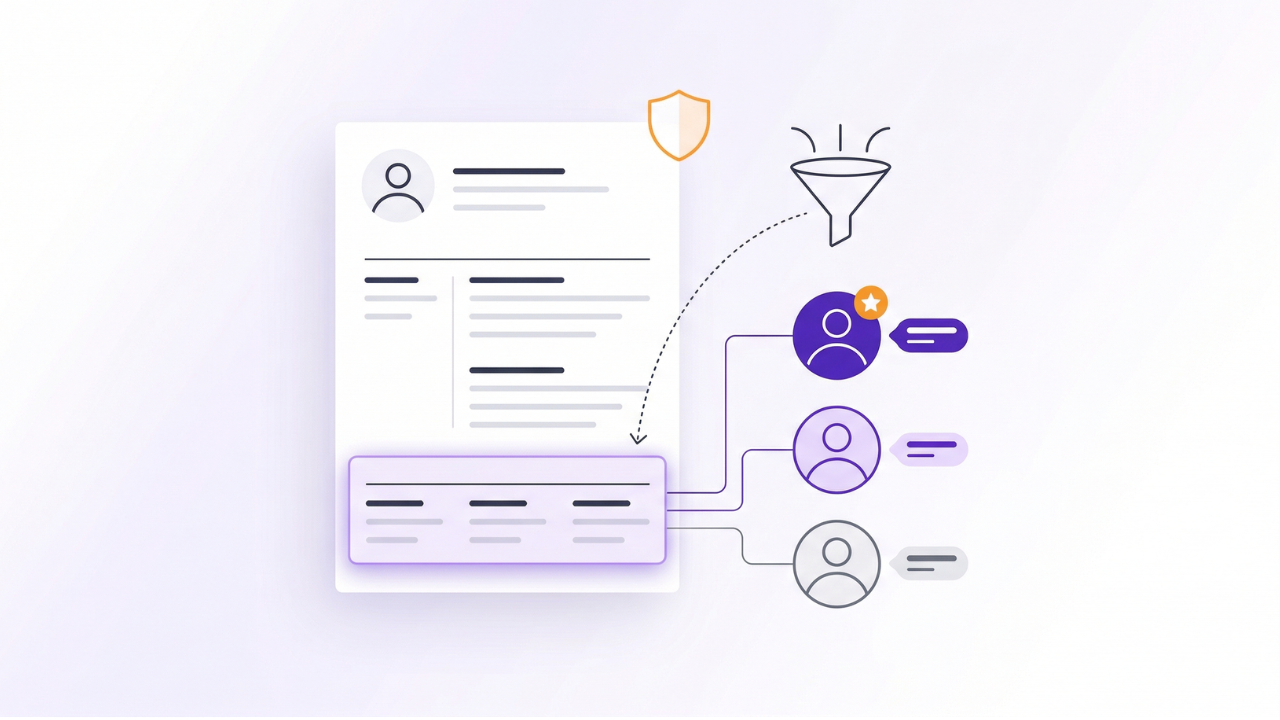
The rules for listing references have shifted over the past decade. The old "References available upon request" footer is now seen as dated filler. At the same time, putting reference names directly on your CV wastes valuable space and risks exposing your referees' contact details unnecessarily.
So how should you handle references in 2026? This guide covers exactly who to choose, how to format a reference sheet, and how to ask someone to be a reference without awkwardness.
Should You Include References on Your CV?
The short answer: no, not directly on your CV.
Most modern recruiters do not want references on the CV itself. They ask for them after the initial screening, typically at the offer stage. Listing them on your CV takes up space that should be used for your skills, achievements, and work history.
Include references on your CV only if:
- The job posting specifically asks for them. Always follow the employer's stated instructions.
- You are applying for an academic or research position. Academic CVs traditionally include references directly.
- You have a high-profile reference who immediately boosts your credibility. For example, a former CEO or widely-known industry figure who has agreed to advocate for you.
- You are in a small industry where hiring is personal and referrals carry significant weight.
Skip references on your CV if:
- The employer has not asked for them
- You are applying for standard professional roles
- Your CV is already close to the ideal length (see our CV length guide)
- You want to protect your referees' contact information until the shortlist stage
Why "References Available Upon Request" Is Outdated
For decades, CVs ended with the line "References available upon request." In 2026, that phrase is dead weight.
Here is why every career expert now recommends removing it:
- It is obvious. Of course you can provide references on request. Every employer knows this. Saying it signals that you are copying outdated templates.
- It wastes space. The 4 to 5 words used for this line could showcase a skill, an achievement, or a certification.
- It makes your CV look dated. Recruiters see this phrase as a hallmark of older CV templates from the 2000s.
The fix: delete the line entirely. Use the space for meaningful content.
How Many References Do You Need?
3 to 5 references is standard. Most employers ask for 3, some ask for up to 5. Having more than 5 prepared gives you flexibility across different applications.
Your references should cover different perspectives on your work:
- 1 to 2 direct managers (ideally from your most recent roles)
- 1 peer or colleague (someone who worked alongside you)
- 1 mentor or senior figure (optional, strong for leadership roles)
- 1 client or external stakeholder (optional, strong for client-facing roles)
Avoid using friends, family members, or anyone you have not worked with professionally. Employers will recognise these immediately and discount them.
Who to Choose as a Reference
Best choices
- Recent line managers who can speak to your day-to-day performance
- Senior colleagues who supervised projects you worked on
- Clients or external partners who can vouch for your professionalism
- University tutors or dissertation supervisors (for freshers and graduates)
- Volunteer coordinators (for career changers or those with limited work history)
Avoid these as references
- Friends and family members (even if they worked with you)
- People you have lost touch with (they may not remember your work well)
- Anyone with a negative opinion of you (obvious, but worth stating)
- References who cannot speak English (if the employer is English-speaking)
- Current managers (unless you have told them you are job hunting)
For freshers with limited work history, academic references are perfectly acceptable. See our student CV guide for more.
How to Format a Reference Sheet
Create a separate document with the same header as your CV (same name, contact details, font, and margins). This keeps your job application package visually consistent.
Template layout
[Your Name]
[Your Phone] | [Your Email] | [Your LinkedIn]

PROFESSIONAL REFERENCES

Reference 1: [Full Name]
[Job Title], [Company Name]
Relationship: [e.g., Line manager 2022-2025]
Phone: [Phone Number]
Email: [Email Address]

Reference 2: [Full Name]
[Job Title], [Company Name]
Relationship: [e.g., Senior colleague, project lead]
Phone: [Phone Number]
Email: [Email Address]

[Continue for references 3-5]
Full example
Sarah Thompson
07700 900123 | sarah.thompson@email.com | linkedin.com/in/sarahthompson
Professional References
Dr James Patel
Director of Engineering, TechFlow Ltd
Relationship: Direct line manager (2023-2025), oversaw all my projects
Phone: 020 7946 0012
Email: j.patel@techflow.co.uk
Maria Gonzalez
Senior Product Manager, TechFlow Ltd
Relationship: Cross-functional project partner on 3 product launches
Phone: 07700 900987
Email: m.gonzalez@techflow.co.uk
Professor Alan Whitfield
Computer Science Lecturer, University of Manchester
Relationship: Dissertation supervisor and referee since 2022
Phone: 0161 275 6000
Email: a.whitfield@manchester.ac.uk
What to include for each reference
- Full name (including title if they use one)
- Current job title and company
- Relationship to you (how they know your work, timeframe)
- Preferred contact method (email and phone)
- LinkedIn profile URL (optional, adds credibility)
How to Ask Someone to Be a Reference
Never list someone as a reference without asking them first. A surprised referee gives weak answers. Here is how to ask properly.
Step 1: Choose the right communication channel
- Email is the most common and professional channel
- Phone call works well for people you are close to
- In-person conversation is ideal if you still see them regularly
Step 2: Ask with enough notice
Give referees 1 to 2 weeks of warning when possible. This lets them prepare and avoid being caught off guard by a recruiter call.
Step 3: Give them an easy way to decline
Never put pressure on someone to say yes. A reluctant reference is worse than no reference at all. Phrase your ask so they can comfortably say no.
Step 4: Share context
Once they agree, send them:
- Your updated CV
- The job description you are applying for
- Key points you would like them to emphasise
- Timeframe when they can expect to be contacted
Step 5: Thank them afterwards
Send a thank-you message once the reference has been given, regardless of the outcome.
Email template to ask for a reference
Subject: Quick reference request
Hi (Name),
I hope you are well. I am currently applying for (role type) positions and wanted to ask if you would feel comfortable serving as a reference for me.
We worked closely on (project or responsibility) during my time at (company), and I believe you would be best placed to speak to my (specific skills or traits). If you are happy to help, I will send you my updated CV and the specific job descriptions so you have context.
Totally understand if this is not the right time for you. Thanks for considering it, and happy to jump on a quick call if easier.
Best,
(Your name)
When and How to Send Your Reference Sheet
Send your reference sheet when:
- The employer explicitly asks for references during the interview process
- After a final interview, when the hiring manager confirms they want to move forward
- With your initial application if the job posting requires references upfront
Do not send references:
- With every job application automatically
- Before you have been shortlisted
- Without giving your referees a heads up that a call may come soon
Alert your references once you are close to an offer
Once a reference check is imminent, email each of your references:
Hi (Name),
Just a quick heads up: (Company) may be in touch in the next few days for a reference check. The role is (job title) at (company). The hiring manager is (name) and they are particularly interested in my (skills they mentioned).
Thanks again for agreeing to support this. I will let you know how it goes.
Best,
(Your name)
Frequently Asked Questions
Can I use a character reference instead of a professional reference?
Character references can supplement but rarely replace professional references. They are most useful for first-time job seekers or when you are changing careers. For a full guide, see our character reference guide.
What if I cannot use my current manager as a reference?
This is common. Many candidates do not want current managers to know they are job hunting. Use previous managers, senior colleagues, or skip-level supervisors who have moved on. Most employers understand why current managers are unavailable.
How recent should my references be?
Ideally from the past 2 to 3 years. A 10-year-old reference has limited value because your skills, role, and work style have likely changed significantly since then. For career changers, your most recent references are still valuable even if they are from a different industry.
Should I put my referees' work phone numbers or mobile numbers?
Use whatever contact method your referee prefers. Always ask them. Some prefer to be contacted via work email, others via personal mobile. Never assume.
What if a reference gives me a bad review?
This is rare but possible. To minimise risk, only list references who have explicitly agreed and who you trust to speak positively about your work. If you suspect a past manager might give a weak review, do not list them, regardless of how senior they are.
Should I include references on my LinkedIn profile?
Recommendations on LinkedIn are different from references on a CV. LinkedIn recommendations are public endorsements that complement your CV. They do not replace the formal reference check that happens during hiring.
Key Takeaways
- Do not list references directly on your CV unless the job posting asks for them
- The phrase "References available upon request" is outdated; remove it
- Prepare 3 to 5 references on a separate reference sheet
- Use the same header (name, contact details, fonts) as your CV for a cohesive look
- Always ask permission before listing someone as a reference, and give them an easy way to decline
- Share your CV, the job description, and timing context once they agree
- Alert your references when a reference check is imminent, and thank them afterwards