CV Review
The category explainer

AI Resume Checker

How modern AI resume checkers actually work. Five dimensions, the 15 to 20 point spread across major tools, and what to expect from a free check versus a paid subscription. With a side-by-side of the main players.

  • Score in 60 seconds
  • Your CV stays private
  • No sign-up to try
We score your CV across 6 dimensions: keyword match, parseability, formatting, contact info, action verbs and quantified achievements.

Prefer not to upload yet? See a sample report

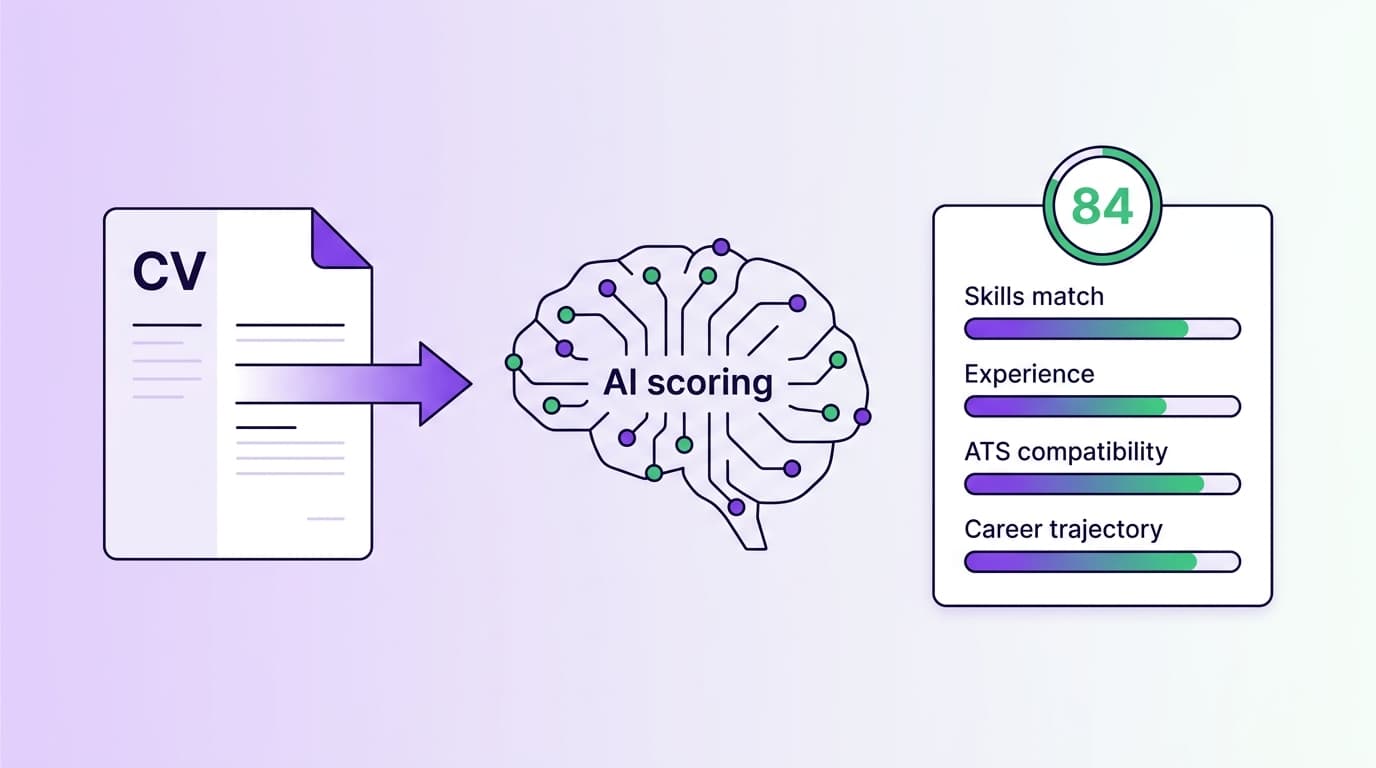
A CV document on the left feeding into a stylised neural-network brain labelled AI scoring, with output on the right showing a scorecard with overall score 84 and four progress bars labelled Skills match, Experience, ATS compatibility and Career trajectory
CV in, AI scoring across multiple dimensions, scorecard out. The pattern every modern AI resume checker follows.

What an AI resume checker actually does

An AI resume checker is the rehearsal for the ATS. It parses your CV the way Workday and Greenhouse will, scores it against the role you are targeting, and tells you which fixes will move the score before you submit. The good ones do this in 60 seconds and return a ranked fix list with quantified impact per fix.

"AI" in the category covers three things older keyword tools did not do: contextual understanding (a bullet about architecture serving 10M users registers as senior backend even without the word "senior"), synonym recognition ("customer support" matches "customer service"), and career trajectory scoring (whether seniority claimed matches responsibility shown).

The category split in 2026 has three groups. Established tools like Jobscan and Resume Worded are strongest at one specific dimension each. Designer-led builders like Enhancv add ATS checking as a feature without it being the focus. And purpose-built scoring tools (including ours) put the parser-specific score and ranked fix list at the centre. Pick by what you need.
How AI scoring works in four stages

The mechanics behind the score. Knowing the stages helps you read the output and spot tools that skip one of them.

  1. 01

    Parse and extract

    The checker extracts structured data from your unstructured CV: name, contact, work history (company, role, dates per entry), education, skills and certifications. Modern AI parsers understand context, not just literal text. A bullet that reads "built a microservices architecture serving 10M users" signals senior distributed-systems experience even if your CV never uses the words "senior engineer".

  2. 02

    Score across multiple dimensions

    Modern checkers score five or six dimensions in parallel: ATS compatibility (parseability), keyword relevance against your target spec, content strength (action verbs, quantification), formatting quality, and overall impact. Each dimension is scored independently so you see exactly where the gap is.

  3. 03

    Compare against a benchmark

    The best checkers benchmark your CV against a population of postings in your function. This is what tells you "your CV is missing the three skills every senior PM posting in 2026 lists" rather than the generic "consider adding more skills". The benchmark is what raw ChatGPT cannot do.

  4. 04

    Return a ranked fix list

    A good output is a ranked list of fixes sorted by score impact, not a paragraph of suggestions. "Move contact info into the body (+10 points)" is actionable. "Consider improving your contact section" is not. Look for tools that quantify the impact of each fix.

The five dimensions modern checkers score

Every reputable AI checker scores at least four of these. The strongest tools score all five and weight them explicitly.

01

ATS compatibility (parseability)

Can major systems (Workday, Greenhouse, Lever, iCIMS, Taleo, SmartRecruiters) extract every field cleanly? This is the foundational dimension. A weak score here means nothing else counts because your record arrives at the recruiter incomplete.

02

Keyword match

How well does your CV mirror the language of a specific job spec, or a benchmark of postings in your function? Mostly exact-match in 2026 but the best models also understand synonyms. The 2025 LinkedIn study found 35 percent higher callback rates for keyword-optimised CVs.

03

Content strength

Quality of bullets: action verbs leading each one, quantification (percentages, time, money), specificity. Resume Worded scores bullets individually on these signals at the highest level of granularity in the market.

04

Formatting quality

Layout (single column), fonts (parser-safe), section headings (standard), file format (.docx safer than PDF), date conventions, contact placement. Most of the "fast 30 minute" lift in score comes from this dimension.

05

Career trajectory and impact

Newer dimension in 2026 models. Looks at whether the seniority claimed in titles matches the responsibility shown in bullets, whether the career arc reads forward (promotions, expanded scope) or sideways, and whether the role-to-role transitions track a coherent narrative.

The main AI resume checkers, side by side

The 2025 cross-tool study found a 15 to 20 point spread across these tools on identical CVs. Scores are not comparable, but each has a clear strength. Pick the tool that matches the dimension you are trying to improve.

ToolStrength
JobscanEstablished keyword-matching tool with 12-year data corpus. Most granular per-job-spec keyword analysis.
Resume WordedScores individual bullets on specificity, impact language and metrics. 250,000+ phrase database.
EnhancvStrongest template quality, best for creative roles where design matters as much as parsing.
cv-review.comSix dimensions, parser-specific notes per major ATS, ranked fix list with quantified impact per fix, re-score after edits.

For the comparison framed against an alternative approach (using ChatGPT for the same task), see ChatGPT vs purpose-built AI for resume review. For the free side of the choice, see free CV review.

Six things to look for in an AI resume checker

  • A real score, not just a colour-coded grade
  • Per-dimension breakdown (not just one number)
  • Parser-specific notes per major ATS, not generic advice
  • Quantified impact per fix in the recommendation list
  • Re-score after edits, so you can measure progress
  • No card required on the free check

Run the free check now

60 seconds, six dimensions, parser-specific notes for Workday, Greenhouse, Lever and the other major systems. No card.

Get my free AI check

Frequently asked questions

Everything we get asked about AI resume checkers, how they differ from ATS, and how to pick between them.