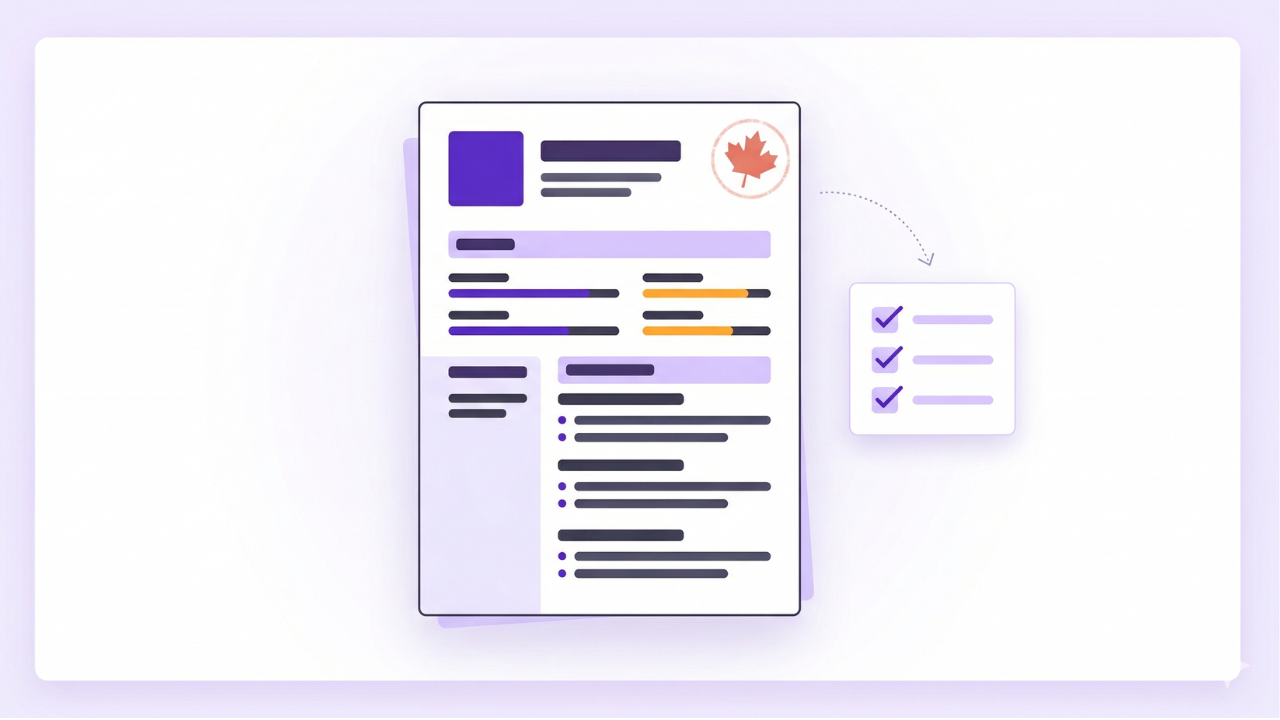
The Canadian job market has its own conventions. Resumes that work in the UK or Europe often need to be adjusted to match Canadian expectations. The good news is that the changes are mostly small, but the small details matter.
This guide covers exactly how to write a Canadian resume in 2026, what to leave out, what to include, and how to localise your application for Canadian employers.
What Makes a Canadian Resume Different?
A Canadian resume has specific conventions shaped by privacy law, employment equity principles, and hiring practices. The most important differences are:
- No personal details like age, marital status, nationality, or photo (Canadian hiring practices prioritise fairness)
- Canadian English spelling (colour, behaviour, centre, organised)
- Metric measurements (kilometres, kilograms, Celsius)
- Focus on quantified achievements over job duties
- Reverse-chronological format (most recent role first)
- 1-2 pages for most roles (longer for senior or academic)
Canadian Resume Structure
- Header (name, city, phone, email, LinkedIn)
- Professional summary (3-4 sentences)
- Skills (grouped, keyword-rich)
- Work experience (reverse-chronological, achievement-focused)
- Education (degree, institution, dates)
- Certifications and professional development
- Volunteer work or community involvement (optional but valued)
Canadian Resume Example
Maria Gonzalez
Toronto, ON | 647-555-0199 | maria.gonzalez@email.com
linkedin.com/in/mariagonzalez
Best Skills for Your CV
---
References on Your CV
Senior Digital Marketing Manager | 7 Years in B2B SaaS
Word Count Target: 2,000-2,500
---
Summary
Senior digital marketing manager with 7 years of experience growing B2B SaaS brands across Canadian and international markets. Most recently led a team of 4 at TechFlow, growing organic traffic from 40K to 280K monthly sessions. Proficient in SEO, paid media, and marketing automation. Google Analytics and HubSpot certified. Bilingual in English and French.
---
Skills
- Marketing: SEO, Google Ads, Meta Ads, LinkedIn Ads, HubSpot automation, content strategy
- Analytics: Google Analytics 4, Looker Studio, Mixpanel, SQL (intermediate)
- Languages: English (native), French (B2 written, B2 spoken)
---
Work Experience
Senior Digital Marketing Manager | TechFlow Inc. | Toronto, ON | Jan 2023 - Present
- Led a team of 4 specialists across content, paid media, and lifecycle marketing
- Grew organic traffic from 40,000 to 280,000 monthly sessions over 18 months through SEO and content strategy
- Managed an annual paid budget of $500,000 CAD with a consistent 4:1 ROAS
- Launched the French-language version of the marketing site, contributing $180,000 CAD in new Quebec pipeline in Year 1
Digital Marketing Manager | Fintech Co. | Toronto, ON | Aug 2020 - Dec 2022
- Built the company's first marketing attribution model using HubSpot and Google Analytics
- Shifted 25% of paid budget to higher-performing channels, reducing customer acquisition cost by 18%
- Grew email subscriber list from 3,500 to 28,000 through gated content campaigns
---
Education
BA Marketing | York University | Toronto, ON | 2015-2019
- Dean's List (top 10% of cohort)
---
Certifications
- Google Ads Certification (2024)
- HubSpot Inbound Marketing Certification (2023)
- Google Analytics 4 Certification (2024)
---
Community Involvement
- Volunteer mentor, Women in Tech Canada (2022-present)
- Conference speaker, Marketing Toronto Summit (2024)
Section-by-Section Guide
Header
Include:
- Full name
- City and province (e.g., "Toronto, ON"). Province abbreviations are standard.
- Phone number (Canadian format, e.g., 647-555-0199)
- Professional email (firstname.lastname@gmail.com is fine)
- LinkedIn URL
Do not include:
- Full home address
- Photo
- Date of birth
- Marital status
- Social Insurance Number (SIN)
- Nationality (unless specifically relevant to work authorisation)
Professional Summary
A 3-4 sentence summary at the top. Similar to a standard CV summary, but with Canadian spelling and local references where relevant.
Skills Section
List 8-12 skills grouped by category. If you are bilingual in English and French, mention it explicitly.
Work Experience
Use reverse-chronological order: most recent role first. Include:
- Job title
- Company name and location (city, province)
- Dates (month and year)
- 3-5 achievement-focused bullet points per role
Quantify wherever possible. Canadian employers value measurable impact.
Education
Include your degree, institution, location (city, province), and dates. If you are a recent graduate, add your GPA (if strong), relevant coursework, and honours.
Certifications
List current certifications with year. Include both Canadian and international certifications.
Volunteer Work and Community Involvement
Canadian employers value community involvement more than most other regions. If you volunteer regularly, mention it in its own section. This is especially helpful for newcomers and people changing careers.
Key Canadian Spelling to Use
Canadian English differs from American English in several ways. Use Canadian spelling throughout:
Canadian English is generally closer to British than American conventions, but there are exceptions. When in doubt, use the Canadian Oxford Dictionary as your reference.
Metric Measurements
Always use metric:
- Distance: kilometres, not miles
- Weight: kilograms, not pounds
- Temperature: Celsius, not Fahrenheit
- Fuel: litres, not gallons
For construction, manufacturing, and logistics roles where measurement matters, this is especially important.
What NOT to Include on a Canadian Resume
1. Photo
Unlike some European countries, Canadian resumes do not include photos. Canadian hiring laws protect against discrimination, and employers deliberately avoid photos to reduce unconscious bias.
2. Age or date of birth
Never include these. Age discrimination is prohibited under Canadian human rights legislation.
3. Marital status, family details, or dependants
Personal family information has no place on a Canadian resume.
4. Religion or political affiliation
Unless directly relevant (e.g., applying for a religious organisation), leave these off.
5. Social Insurance Number (SIN)
Your SIN is for payroll, not job applications. Never include it.
6. Full home address
City and province are enough. Full address raises privacy concerns and is not expected.
7. Physical descriptions
Height, weight, and general physical traits do not belong on a Canadian resume.
8. References
Have them ready on a separate reference sheet, but do not include them on the resume itself. Never write "References available upon request."
Bilingual Resumes (English and French)
If you are applying in Quebec or bilingual roles elsewhere in Canada, consider the following:
Option 1: Single English resume
Standard in most of Canada, including English-speaking parts of Quebec. Mention French language proficiency in your skills section.
Option 2: Single French resume
Required for many Quebec-based roles, especially in the public sector or small local businesses.
Option 3: Bilingual resume
Some applicants submit both versions (English and French) as 2 separate files. This is common for federal government roles and bilingual private-sector positions.
Language proficiency labels
Use the Common European Framework (CEFR) levels:
- A1/A2: Basic
- B1/B2: Intermediate
- C1/C2: Advanced / Fluent
- Native
Example: "French: C1 written, B2 spoken"
Newcomers to Canada: Special Tips
If you are applying to Canada from abroad, consider these additional tips.
1. Localise your work experience
Use Canadian equivalents of job titles where possible. A "Business Development Executive" in the UK might be called a "Business Development Representative" in Canada.
2. Convert currencies
If you mention revenue or budgets, convert to CAD. Canadian employers prefer CAD references.
3. Highlight Canadian certifications
Where possible, pursue and list Canadian certifications (e.g., CPA Canada, PMP through Canadian chapters, Canadian Securities Course).
4. Address work authorisation clearly
If you have Canadian work permission (citizen, PR, or valid work permit), mention it explicitly in your cover letter. If you need sponsorship, address it directly rather than hiding it.
5. Mention Canadian experience (even volunteer)
Volunteering in Canada, internships, or any Canadian-based work strengthens your application. Include even short-term involvement.
Canadian Resume Length
Standard guidance:
- Entry-level / new graduates: 1 page
- Mid-career professionals: 1-2 pages
- Senior and executive roles: 2 pages (occasionally 3 for very senior)
- Academic / research: 3+ pages
For more detail on length, see our CV length guide.
ATS in Canada
Canadian employers increasingly use ATS software. The most common platforms include Workday, Taleo, SAP SuccessFactors, Greenhouse, and ADP Workforce Now.
The same ATS rules apply:
- Use standard section headings
- Mirror language from the job posting
- Avoid tables, images, and multi-column layouts
- Save as .docx or text-based .pdf
- Include both full terms and acronyms (e.g., "Project Management Professional (PMP)")
Provincial Differences
Most Canadian resume conventions are nationwide, but some provincial variations exist.
Quebec
- Often bilingual or French-only resumes expected
- Quebec has specific language law (Bill 96) requiring French-language applications for many roles
- Cultural references and networks carry more weight
Ontario and British Columbia
- Largely English-only resumes
- Highly multicultural hiring markets
- Federal hiring practices strongly enforced
Alberta and Saskatchewan
- Energy and resource-industry hiring has specific certifications (H2S, First Aid, etc.)
- Often more conservative CV style
Atlantic Provinces
- Smaller job markets favour local networks
- Volunteer work and community involvement weighted heavily
Frequently Asked Questions
Is "CV" or "resume" the right term in Canada?
In most of Canada, "resume" is the standard term for a 1-2 page document. "CV" typically refers to academic documents. In Quebec, the terms are often used interchangeably. For a full comparison, see our CV vs resume guide.
Should I mention my immigration status?
Only in your cover letter, and only to confirm you have work authorisation. Do not put it on the resume itself. If you need sponsorship, be upfront but brief about it.
How important is French in Canada?
Essential for Quebec-based roles and federal government positions. Useful for any national role. Not necessary for most English-Canada private-sector jobs.
What if my qualifications are from outside Canada?
List them clearly with the country of origin. If you have had them assessed for Canadian equivalency (through WES or similar services), mention that too.
Should I include volunteering on a Canadian resume?
Yes, especially if you are a newcomer or have gaps. Community involvement is valued in Canada and can be the factor that tips you over the line. See our hobbies guide for what to include.
What is the best format for a Canadian resume?
Reverse-chronological for most roles. Use a functional format only if you have significant career gaps or are making a major career change. See our resume objective guide for first-time and career-changer positioning.
Key Takeaways
- Use a 1-2 page reverse-chronological format with clear sections
- Exclude personal details like age, marital status, photo, and full address
- Use Canadian English spelling (colour, behaviour, centre, organised)
- Use metric measurements throughout
- Highlight bilingual ability (English and French) if applicable
- Include volunteer work and community involvement where relevant
- Save as .docx or text-based .pdf for ATS compatibility
- For Quebec roles, consider a French version or bilingual application