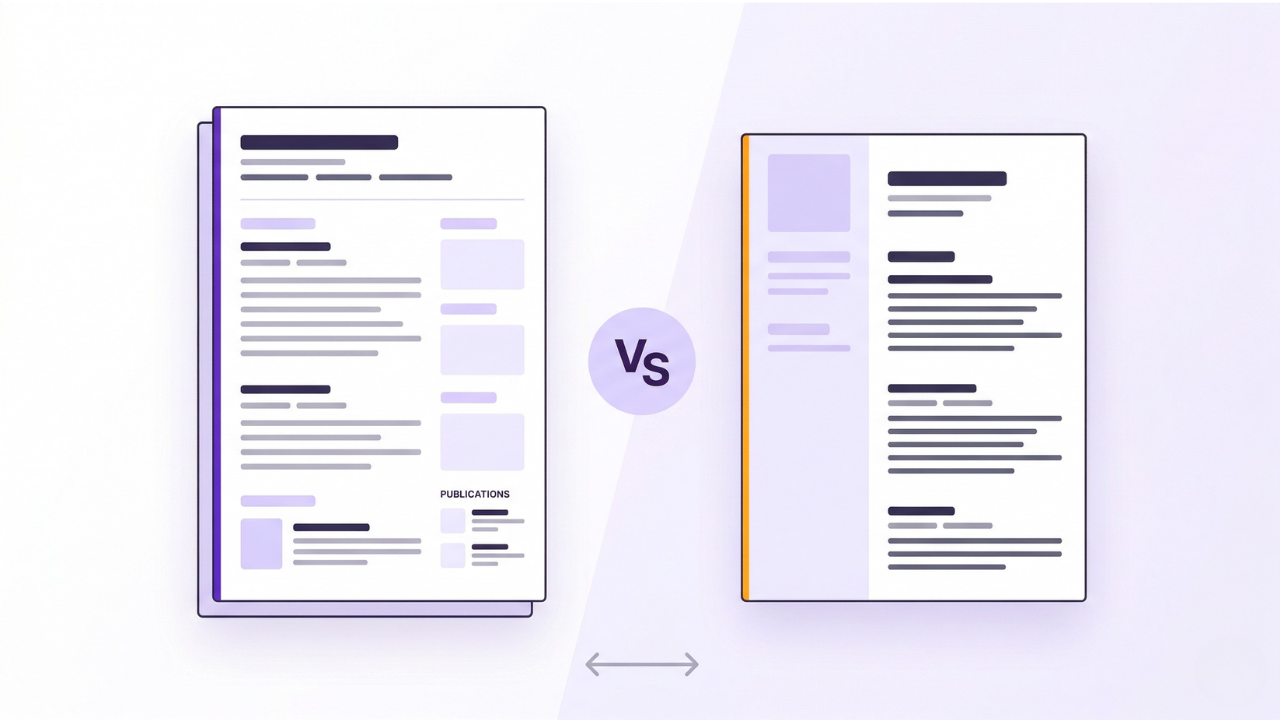
"Send me your CV" and "send me your resume" sound like the same instruction, but in different countries they mean different things. A single document label can decide whether your application is taken seriously.
This guide explains exactly what the difference is, when to use each, how the conventions vary by country, and how to choose the right one for every application.
What Does CV Stand For?
CV stands for Curriculum Vitae, Latin for "course of life." Originally, it referred to a detailed, often multi-page document covering your entire academic and professional history.
In its classical sense, a CV includes:
- Education (in detail)
- Research experience
- Teaching experience
- Publications
- Presentations and talks
- Awards and honours
- Grants and funding
- Professional memberships
- References
A traditional academic CV can easily run 4 to 10 pages.
What Is a Resume?
A resume (from French, meaning "summary") is a short document (1-2 pages) that summarises your most relevant qualifications for a specific job.
A resume includes:
- Contact details
- Work experience
- Education
- Certifications
- Optional: hobbies, volunteer work
Resumes are tailored for each application, focusing on what is most relevant for the specific role.
CV vs Resume: A Side-by-Side Comparison
CV vs Resume by Country
Here is where it gets confusing. The same words mean different things depending on where you are applying.
United Kingdom, Ireland, Australia, New Zealand
"CV" is the default term for all job applications. When a UK employer asks for your CV, they mean a 1-2 page document summarising your qualifications, equivalent to what Americans call a resume.
Academic CVs still exist separately and follow the traditional long format.
United States and Canada
"Resume" is the standard term for job applications. When a US or Canadian employer asks for your resume, they mean a 1-2 page document.
"CV" in the US and Canada typically refers specifically to the academic, research-focused, multi-page version. It is used for:
- Academic job applications
- Research positions
- Medical residencies and fellowships
- Grant applications
- Scientific roles at universities and research institutions
For help with Canadian job applications specifically, see our Canadian resume format guide.
Continental Europe
Mixed usage. Many European countries use "CV" to mean the same as the UK version. The Europass CV (a standardised European format) is widely accepted.
India
Both "CV" and "resume" are used interchangeably. Most Indian employers do not distinguish strongly between them, though "biodata" is also used in some contexts for very detailed personal documents.
South Africa
"CV" and "resume" are used interchangeably, with CV being slightly more common in standard job applications.
Quick Decision Framework
Use this flowchart to decide which to send:
- Where is the job? If UK/Ireland/Australia/NZ, use "CV" (1-2 page version).
- Is it academic/research/medical? Use a full academic CV regardless of country.
- Is it US/Canada and not academic? Use a "resume" (1-2 pages).
- What does the job posting say? If the posting asks for a "CV" or "resume" specifically, follow that instruction exactly.
How to Convert a CV to a Resume
If you have a long academic CV and need a short resume for a non-academic role:
Step 1: Identify the target role
Read the job description carefully. Highlight the top 5 requirements.
Step 2: Keep only relevant sections
Drop sections that do not directly support your application:
- Remove or condense publications (unless they are directly relevant)
- Remove or condense presentations
- Simplify teaching history into 2-3 bullets
- Shorten early education detail
Step 3: Add a CV summary
See our CV summary guide. A summary is essential for a resume but usually absent from an academic CV.
Step 4: Strengthen the skills section
Academic CVs often skip skills sections. For a resume, a strong skills section is essential, especially for ATS screening.
Step 5: Quantify achievements
Academic CVs often describe activities. Resumes describe outcomes. Rewrite each bullet to include numbers where possible.
Step 6: Cut to 1-2 pages
Ruthless editing is required. For help deciding length, see our CV length guide.
Real Examples
Academic CV style (traditional)
Publications
- Carter, L., Patel, R., and Wilson, E. (2024). "Machine Learning Approaches to Urban Traffic Prediction." Journal of Transportation Studies, 45(3), 112-129.
Presentations
- "Real-Time Traffic Forecasting Using Neural Networks." International Transportation Conference, Manchester, June 2024.
Teaching Experience
- Teaching Assistant, CS201 Introduction to Programming, University of Manchester (2022-2024)
- Teaching Assistant, CS305 Machine Learning, University of Manchester (2023-2024)
Resume style (modern)
Senior Data Analyst | TechFlow | 2023-Present
- Built automated Tableau dashboards that reduced manual reporting by 60%
- Led a pricing analysis identifying £200K in annual revenue opportunities
- Designed A/B tests that increased activation rates from 42% to 58%
Notice the difference: the academic CV describes what you did; the resume shows impact and outcomes.
Common Confusions
"CV" in the UK means "resume" in the US
This is the most common confusion. If you are in the UK and a US employer asks for a "CV," they likely mean an academic-style document. If a UK employer asks for a "CV," they mean what an American would call a resume.
Academic CVs and business resumes should not be interchangeable
Sending a 6-page academic CV to a corporate recruiter will often get rejected. Sending a 1-page resume to a university department for a research position is equally mismatched.
Bilingual regions
In Quebec and parts of Switzerland or Belgium, a CV or a resume may be expected in either language. Always check the posting for language preference.
Which Document Type Should You Create?
If you are in the UK, Australia, or New Zealand
Create a 1-2 page CV that matches what Americans call a resume. That is your default document.
If you are in the US or Canada
Create a 1-2 page resume for most applications. Create a separate academic CV only if you are applying for research, university, or medical roles.
If you are applying internationally
Prepare both. Name the UK/Aus-style document "CV" and the US-style document "Resume" on the file names ("LastName_CV.pdf" vs "LastName_Resume.pdf"). Send whichever the employer asks for.
If you are in academia (any country)
You will need a full academic CV (multi-page) for research and teaching positions, and a shorter resume-style document for non-academic industry roles.
ATS and the CV vs Resume Question
For ATS screening, the terminology does not matter. What matters is:
- Clean formatting (single column, standard headings)
- Standard file format (.docx or .pdf)
- Relevant keywords from the job description
- Quantified achievements
Whether you call it a CV or a resume, an ATS parses the content the same way.
Frequently Asked Questions
Should I label my file "CV" or "Resume"?
Match the employer's terminology from the job posting. If they say "submit your CV," call the file "FirstName_LastName_CV.pdf." If they say "resume," use "FirstName_LastName_Resume.pdf."
What is a biodata, and is it the same as a CV?
Biodata is an older, more personal format still used in some regions (especially India and Southeast Asia). It typically includes personal details (family, marital status, religion) that modern Western CVs exclude. For most professional applications today, a CV or resume is preferred.
How long is an academic CV?
As long as necessary to cover your full academic history. For a senior professor, 10+ pages is normal. For a junior researcher, 2-4 pages is typical.
Do I need both a CV and a resume?
If you apply across different regions or sectors, yes. Maintain both: a short resume-style document for standard applications and a longer academic CV if relevant.
Is there a difference in content beyond length?
Yes. Academic CVs include publications, presentations, and teaching history. Resumes focus on quantified business impact, skills, and concise work experience. Academic CVs use neutral descriptions of activity. Resumes use achievement-focused language.
What should I call it on LinkedIn?
LinkedIn does not require you to use either term. Your LinkedIn profile is neither, but if you upload your document, label it to match your current job market.
Key Takeaways
- "CV" in the UK, Ireland, Australia, and New Zealand = a 1-2 page document (equivalent to a US resume)
- "CV" in the US and Canada = a long academic/research document (multi-page)
- "Resume" = a 1-2 page summary, used in the US and Canada for standard job applications
- Always match the terminology the job posting uses
- Academic roles require a traditional long CV regardless of country
- Convert between the two by editing for length, adding a summary, and quantifying achievements