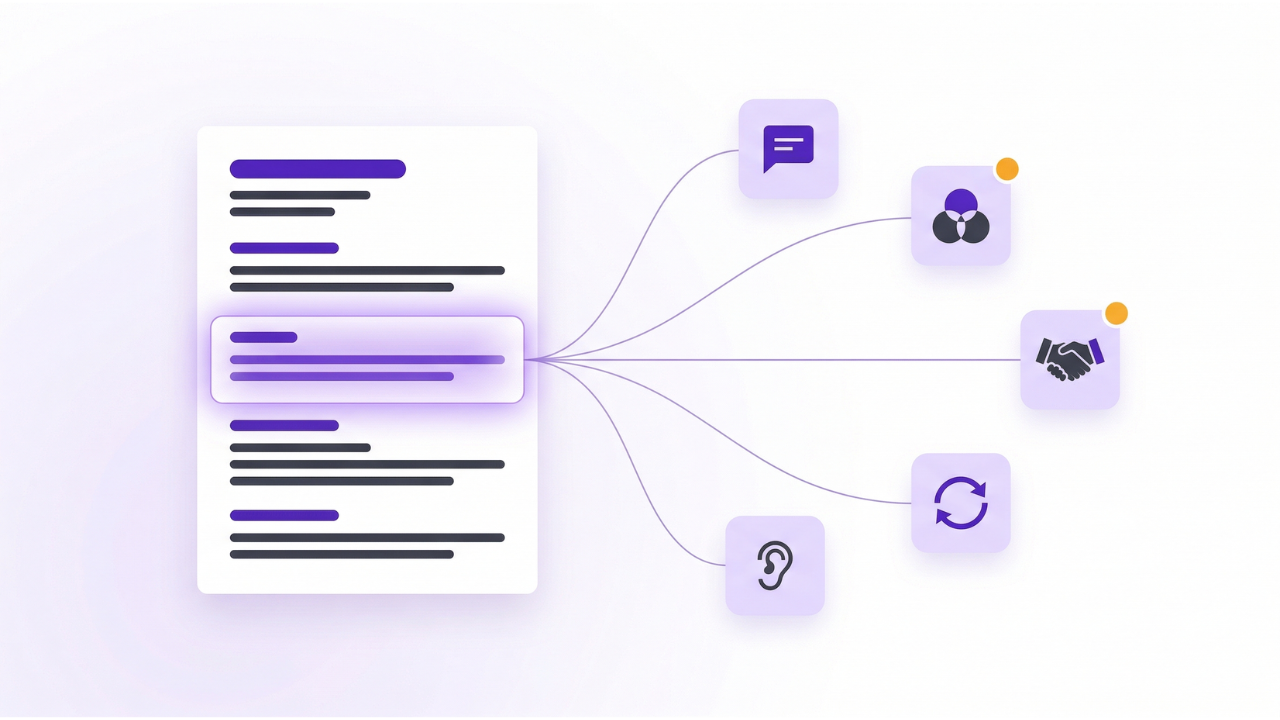
Interpersonal skills are the qualities that decide whether a candidate with perfect technical qualifications gets hired or passed over. In 2026, with AI automating more routine work, employers are valuing interpersonal skills more than ever. 62% of hiring managers now rate soft and hard skills as equally important, with 24% saying soft skills matter more.
This guide covers what interpersonal skills are, which ones employers value most, and exactly how to showcase them on your CV and in interviews.
What Are Interpersonal Skills?
Interpersonal skills (sometimes called "people skills" or "social skills") are the qualities and behaviours that shape how you communicate, collaborate, and build relationships with others at work. They are a core subset of soft skills.
Unlike hard skills (like SQL, accounting, or design software), interpersonal skills are harder to measure. Employers assess them through:
- Interview conversations
- Behavioural interview questions
- References from former managers
- Trial shifts or working interviews
- Case studies and group exercises
Strong interpersonal skills are the difference between a technically competent employee and a genuinely effective one.
Why Interpersonal Skills Matter So Much in 2026
Hiring priorities have shifted. Here are the reasons:
1. AI is automating the technical, not the human
As AI takes over routine technical work, the remaining human value sits in collaboration, empathy, and communication. Employers are actively hiring for what AI cannot replace.
2. Remote and hybrid work have raised the bar
When you cannot rely on hallway conversations and ambient team presence, written communication, async collaboration, and emotional intelligence matter more.
3. Cross-functional teams are the default
Most modern roles require working with people across different functions. Strong interpersonal skills let you move information smoothly across those boundaries.
4. Employers are making longer-term bets
Hiring is expensive. Employers want people who can grow, adapt, and fit in culturally. Strong interpersonal skills signal that potential.
The 10 Most Valued Interpersonal Skills
1. Communication
Both verbal and written. The ability to explain your ideas clearly, tailor your style to different audiences, and be understood. This is the umbrella skill most others rely on.
2. Active listening
Truly hearing what someone is saying, including what is implied. Active listeners ask clarifying questions, paraphrase, and build on others' ideas rather than just waiting for their turn to speak.
3. Empathy
Understanding others' perspectives, motivations, and emotional states. Empathy drives better decisions, stronger client relationships, and healthier team dynamics.
4. Collaboration
Working effectively across different personalities, working styles, and priorities. The best collaborators know how to compromise without losing sight of the goal.
5. Conflict resolution
Addressing disagreements directly, fairly, and constructively. Avoiding conflict is often worse than handling it well. Skilled professionals do the latter.
6. Relationship building
The ability to build and maintain long-term professional relationships. Useful in sales, client services, leadership, and almost every role involving external stakeholders.
7. Negotiation
Finding outcomes where both sides get enough of what they need. Present in sales, procurement, project work, and every role involving trade-offs.
8. Mentoring and coaching
Developing others. A signal of seniority and emotional maturity, highly valued in management and senior IC roles.
9. Cultural awareness
Working effectively with people from different backgrounds, cultures, and experiences. Particularly important in global teams and diverse client bases.
10. Emotional intelligence
The meta-skill: knowing your own emotions, recognising others', and adjusting your behaviour accordingly. This underpins most of the skills above.
How to Demonstrate Interpersonal Skills on Your CV
Listing "excellent interpersonal skills" in a bullet is meaningless. Employers have read it thousands of times. The way to communicate these skills is through evidence.
Method 1: Use the skills section strategically
Group soft skills in your skills section under a category like "Soft skills" or "Interpersonal skills." Keep it to 4-6 specific ones.
Soft skills: Cross-functional collaboration, stakeholder communication, conflict resolution, mentoring
Method 2: Reference specific skills in work experience bullets
The strongest way to show interpersonal skills is through achievements that could not have happened without them.
Communication:
"Presented quarterly performance reviews to C-suite; 3 of my recommendations adopted into the annual plan"
Collaboration:
"Led a cross-functional team of 8 (engineering, design, marketing, sales) through a 6-month product launch"
Conflict resolution:
"Mediated a dispute between two senior leads that had stalled an initiative for 3 weeks, getting the project back on track within a week"
Mentoring:
"Mentored 3 junior analysts; 2 were promoted to senior roles within 18 months"
Negotiation:
"Renegotiated a key supplier contract, reducing costs by 22% while maintaining delivery timelines"
Method 3: Include volunteer or extracurricular roles
Volunteer and community roles often showcase interpersonal skills more vividly than paid work. See our hobbies on CV guide for how to include them.
Better Alternatives to Overused Terms
Some interpersonal skill terms appear on millions of CVs and carry no weight. Use stronger alternatives.
For more synonyms, see our how to describe yourself guide.
Industry-Specific Interpersonal Skills
Different industries value different interpersonal skills. Tailor your CV to match.
Healthcare
- Empathy with patients and families
- Calm communication under pressure
- Active listening with patients
- Clear documentation and handover
- Multidisciplinary teamwork
See our medical assistant CV guide.
Technology
- Cross-functional communication (with non-technical stakeholders)
- Code review etiquette
- Async communication
- Technical writing
- Mentoring junior engineers
See our engineering CV guide.
Finance and consulting
- Executive communication
- Stakeholder management
- Client relationship building
- Negotiation
- Presentation skills
Sales and customer success
- Relationship building
- Empathy with client pain points
- Conflict resolution
- Negotiation
- Storytelling
Education
- Patience
- Cultural awareness
- Coaching and feedback
- Parent and guardian communication
- Classroom management
Hospitality
- Customer service
- Calm under pressure
- Team coordination during rushes
- Conflict resolution with difficult guests
- Upselling through rapport
See our server CV guide.
How to Demonstrate Interpersonal Skills in Interviews
Your CV gets you in the door. Interviews are where interpersonal skills are tested directly.
1. Prepare STAR-method answers
Most behavioural interview questions test interpersonal skills. Use the STAR method (Situation, Task, Action, Result) to structure your answers.
Example question: "Tell me about a time you resolved a conflict."
Situation: Two team leads disagreed about the launch timeline.
Task: I was asked to mediate before it escalated.
Action: I met with each separately to understand their positions, then facilitated a joint meeting with a clear agenda.
Result: We aligned on a revised timeline, and both leads signed off in writing.
2. Prepare for specific interpersonal questions
Common questions testing interpersonal skills include:
- "Tell me about a time you disagreed with a colleague"
- "Describe a time you had to give difficult feedback"
- "How do you handle a difficult stakeholder?"
- "Tell me about a time you mentored someone"
- "How do you adapt your communication style?"
For more interview prep, see our guides on:
3. Show interpersonal skills live
Beyond your answers, your behaviour during the interview signals your interpersonal skills. Make eye contact, listen carefully, ask thoughtful questions, and match the interviewer's formality level.
Common Interpersonal Skills Synonyms
If you want to vary the language on your CV, here are alternatives for the most common terms.
Communication
- Articulate
- Fluent
- Concise writer
- Persuasive
- Clear communicator
- Effective presenter
Collaboration
- Team-oriented
- Cross-functional
- Cooperative
- Partnership-minded
- Supportive
Empathy
- Understanding
- Compassionate
- Client-focused
- Patient-centred
- Thoughtful
Leadership
- Motivating
- Decisive
- Accountable
- Visionary
- Coaching-oriented
Problem-solving
- Resourceful
- Analytical
- Strategic
- Systematic
- Solution-focused
Common Mistakes When Listing Interpersonal Skills
1. Listing them without evidence
"Excellent interpersonal skills" is meaningless. Back every claim with a specific example.
2. Using generic terms
"Team player" and "people person" are forgettable. Use specific terms that reflect real behaviour.
3. Overloading the skills section
Three to five interpersonal skills are enough. More starts to dilute the signal.
4. Confusing soft skills with personality traits
Being "friendly" is a trait, not a skill. "Customer-focused" or "empathetic with clients" is a skill.
5. Repeating the same skill in different words
If you list "collaboration," do not also list "team player" and "cooperative." Pick one.
6. Missing industry-specific skills
If the job description calls for "stakeholder management," "cross-functional leadership," or "bedside manner," use those exact terms.
Frequently Asked Questions
Can you teach interpersonal skills?
Yes, though it takes time. Coaching, therapy, deliberate feedback, and communities of practice (like Toastmasters) all help. Employers value candidates who actively develop their interpersonal skills.
What is the difference between soft skills and interpersonal skills?
Interpersonal skills are a subset of soft skills. Soft skills include interpersonal ones plus broader qualities like adaptability, time management, and problem-solving. Interpersonal skills specifically relate to how you interact with others.
How do I prove interpersonal skills if I do not have professional experience?
Draw from volunteer work, group projects, extracurriculars, and part-time jobs. Leadership in a society, organising a community event, or leading a group project all count. See our student CV guide for more.
Do interpersonal skills help with ATS screening?
Somewhat. Some ATS systems match on soft skill keywords if they appear in the posting. More importantly, they help once a human reviews your CV. For more on ATS, see our ATS guide.
Should I mention introversion as a strength?
Not in those words. Rather than "introvert," describe specific strengths: "thoughtful written communicator," "strong listener," "deeply focused on individual client relationships." These reframe introvert qualities as interpersonal strengths.
How many interpersonal skills should I list on my CV?
Three to five, chosen carefully based on the job description. Each should be backed by evidence in your work experience section.
Key Takeaways
- Interpersonal skills are the qualities that determine how well you communicate, collaborate, and build relationships at work
- In 2026, 62% of hiring managers rate soft and hard skills equally; 24% say soft skills matter more
- The 10 most valued interpersonal skills include communication, active listening, empathy, collaboration, conflict resolution, and emotional intelligence
- Always back interpersonal skills with specific examples in your work experience
- Avoid generic terms ("good communicator," "team player") in favour of specific alternatives
- Match your interpersonal skill language to the job description
- Prepare STAR-method answers for behavioural interview questions