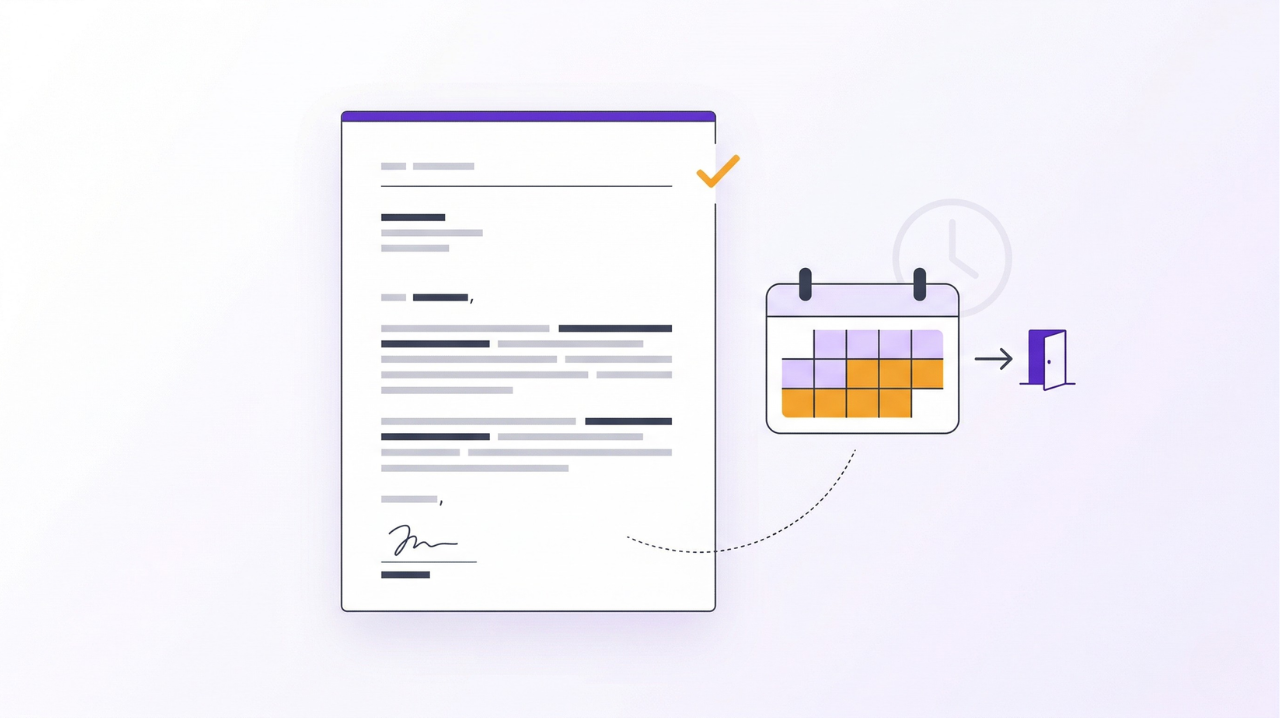
Two weeks notice is the standard minimum notice period for most professional roles in the US and UK. It gives your employer time to prepare for your departure, lets you wrap up your work cleanly, and protects your professional reputation when you move on.
The letter itself is short and straightforward, but the tone matters. This guide walks through exactly how to write one, with multiple templates for different situations, plus guidance on what to do before and after you hand it in.
What Is a Two Weeks Notice Letter?
A two weeks notice letter is a short, formal letter that tells your employer you are resigning and specifies your last working day as 2 weeks from the date the letter is submitted.
It serves three purposes:
- Creates a formal paper trail of your resignation
- Triggers your notice period and handover responsibilities
- Sets the tone for a professional exit
The letter itself is only half the process. The conversation you have with your manager when you submit it matters equally.
Is Two Weeks Notice Legally Required?
In most countries, notice periods are governed by your employment contract rather than law. Check yours before resigning.
Typical notice periods by role level:
Two weeks is the standard minimum. Giving less than this can damage your reputation even if it is technically legal. Giving more is often appreciated, especially if your role is complex.
For more on the full resignation process, see our resignation letter templates guide.
How to Write a Two Weeks Notice Letter (Step by Step)
Step 1: Decide on your last working day
Count forward 2 weeks (10 working days) from the day you submit the letter. Make this date clear in the letter itself.
Step 2: Open with a direct statement of resignation
No softening or vague language. State clearly that you are resigning and from which role.
Step 3: Confirm your last day
Make the date specific and unambiguous. Use the full date format, not "next Friday."
Step 4: Offer support for the handover
Commit briefly to helping with the transition. This is what preserves goodwill.
Step 5: Thank them (briefly)
One short sentence of gratitude is enough. Avoid over-effusive thanks if it does not feel sincere.
Step 6: Sign off professionally
Standard formal sign-off ("Yours sincerely" or "Best regards") and your name.
Two Weeks Notice Letter Template
[Your Full Name]
[Your Email] | [Your Phone]
[Date]

[Manager's Name]
[Manager's Title]
[Company Name]

Dear [Manager's Name],

I am writing to formally notify you of my resignation from my position as [Your Job Title] at [Company Name]. My last working day will be [Date], giving you 2 weeks' notice.

I am grateful for the opportunity to have worked here, and [one specific positive reflection]. I will do everything I can during these final 2 weeks to support a smooth handover and wrap up my current responsibilities.

Please let me know how I can best support you and the team during the transition.

Yours sincerely,

[Your Full Name]
Two Weeks Notice Email Template
For most modern workplaces, email is the standard delivery method.
Subject: Resignation - (Your Name)
Dear (Manager's Name),
I am writing to formally notify you of my resignation from my position as (Your Job Title). My last working day will be (Date), in line with my 2-week notice period.
Thank you for the opportunity to work with the team. I am committed to supporting a smooth handover during my remaining time, and I will prioritise wrapping up current projects and documenting ongoing work.
Please let me know how I can best support the transition.
Best regards,
(Your Full Name)
5 Examples for Different Situations
Example 1: Moving to a New Job
Dear Sarah,
I am writing to formally notify you of my resignation from my role as Senior Account Manager at Blythe & Co. My last working day will be 27 April 2026, in line with my 2-week notice period.
Thank you for the opportunities I have had over the past 3 years. I am particularly grateful for the chance to lead the strategic accounts programme and the development support you have given me.
I will prioritise a clean handover of my accounts during these final 2 weeks, including a detailed brief for my successor and a personal handover call with each of my key clients.
Please let me know how I can best support you.
Yours sincerely,
Aisha Khan
Example 2: Short and Neutral
Dear Rachel,
This letter is to notify you that I am resigning from my role as Marketing Coordinator. My last day will be 27 April 2026.
Thank you for the opportunity. I will do everything I can to support a smooth transition over the next 2 weeks.
Yours sincerely,
Tom Richards
Example 3: With Strong Positive Reflection
Dear Dr Wilson,
I am writing to formally resign from my position as Research Analyst. My last working day will be 27 April 2026, in line with my 2-week notice period.
The past 2 years have shaped me professionally in ways I am deeply grateful for. The research I contributed to on patient outcomes in community care gave me experience and insight I will carry forward into my next role, and your mentorship has meant a great deal.
I am committed to finishing my current project, documenting my workflows, and supporting the onboarding of whoever takes over my responsibilities.
Thank you again.
Yours sincerely,
Emma Richards
Example 4: For a Client-Facing Role
Dear Liam,
I am writing to notify you of my resignation from my role as Senior Consultant. My last day will be 27 April 2026, in line with my 2-week notice period.
Thank you for the opportunities over the past 4 years. I will focus my remaining time on handing over my live client engagements cleanly, including:
- Introducing my successor (or the interim lead) to each client personally
- Documenting project status, budgets, and open decisions
- Transitioning administrative access and file ownership
Please let me know your preference for how to handle the client communications.
Yours sincerely,
James Patel
Example 5: After a Short Tenure
Dear Mr Davies,
I am writing to formally notify you of my resignation from my position as Analyst. My last working day will be 27 April 2026, in accordance with my 2-week notice period.
I am grateful for the opportunity to have worked here. Although my tenure has been shorter than either of us anticipated, I will use my remaining time to close out my current projects and ensure a clean handover.
Thank you for your understanding.
Yours sincerely,
Sophie Laurent
Before You Submit the Letter
Secure your next role first
Never hand in your notice until you have a signed offer from your new employer in writing. A verbal offer is not enough.
Tell your manager in person (or by video) first
The letter is the formal record. The conversation is where the news actually lands. If possible, sit down with your manager and tell them in person before emailing the letter.
Choose the timing carefully
End-of-day on a Monday or Tuesday tends to work best. It gives your manager time to process, plan, and communicate to the team within the same week.
Prepare for the conversation
Have clear answers for likely questions:
- "Why are you leaving?"
- "Is there anything we could do to keep you?"
- "Where are you going?"
- "How can we make the handover work?"
Keep your answers brief and professional. You do not need to justify the move or name your new employer.
What to Do During Your Notice Period
Week 1: Document everything
Spend the first 4 to 5 days of your notice period writing a comprehensive handover document. Cover:
- Your key ongoing projects and their status
- Recurring responsibilities and how you handle them
- Important contacts (internal and external)
- Passwords to update (via your manager, not the new hire)
- Open issues that need decisions
Week 2: Transfer knowledge
Dedicate the second week to transferring knowledge to your team:
- Walk your manager or successor through the handover document
- Introduce them to key clients, vendors, or stakeholders
- Shadow or co-lead any meetings that need continuity
- Leave your team better informed than they would otherwise be
Throughout
Stay engaged and professional. Do not check out mentally or emotionally. The last 2 weeks are often the most memorable part of your tenure for your colleagues.
How to Handle Counter-Offers
Your employer may respond with a counter-offer. Here is how to handle it.
1. Thank them but stand firm
Showing that you value their offer is fine. Accepting it is usually a mistake. Data suggests that 80% of counter-offer acceptances lead to departures within 12 months anyway.
2. Remember why you are leaving
If compensation was the issue, a counter-offer might work. If the reasons were deeper (culture, growth, management, role itself), money will not fix them.
3. Do not use an offer to negotiate
Resigning purely to extract a counter-offer is a reputation-damaging move. Only resign when you have genuinely decided to leave.
After You Leave
Before your last day:
- Write thoughtful farewell messages to close colleagues. See our farewell messages guide for templates.
- Update your LinkedIn profile (but wait until after your manager has communicated your departure internally)
- Connect with colleagues you want to keep in touch with
- Return all company property (laptop, access cards, devices)
After you leave:
- Refresh your CV summary and skills section
- Prepare for your new role's first 90 days
- Maintain ongoing relationships with your former colleagues
Common Mistakes to Avoid
1. Giving less than 2 weeks
Unless your contract explicitly allows less, giving less than 2 weeks damages your reputation. Even if you are miserable, serve your time.
2. Writing a long emotional letter
Two weeks notice letters should be short, professional, and neutral. Emotional letters rarely land well and often come back to haunt you.
3. Complaining in the letter
Even if you have legitimate grievances, the letter is not the place for them. Save any feedback for the exit interview, and even then, keep it measured.
4. Naming your new employer
Your current employer does not need to know where you are going. Unless you have a clear reason to share (e.g., to reassure them you are not going to a direct competitor), keep it generic.
5. "Quiet quitting" during your notice period
Some people use the 2-week window to check out. This is visible to everyone and affects your reputation and references.
6. Telling colleagues before your manager
Do not gossip about your resignation before your manager has had a chance to process it and communicate it officially.
Frequently Asked Questions
Do I need to hand in both a letter and an email, or just one?
In most workplaces, an email is enough. Some formal employers prefer a printed letter submitted in person (or in addition to the email). Always check your contract or HR policy.
Can my employer extend my notice period beyond 2 weeks?
Only if your contract specifies a longer notice period. If your contract says 2 weeks, they cannot unilaterally extend it. If your contract says 1 month, you cannot legally shorten it to 2 weeks without their agreement.
Can I take unused holiday during my notice period?
Usually yes, but it depends on your contract and the company policy. Some employers will pay out unused leave rather than letting you take it. Check with HR.
What happens if my employer asks me to leave immediately?
This is called "garden leave." Your employer may ask you to leave the office immediately but continue paying you for the 2-week notice period. This is common for roles with access to sensitive information.
Can I rescind my resignation?
Technically yes, but your employer does not have to accept the rescission. Once you have resigned, the best assumption is that the decision is final. Do not resign unless you mean it.
What if my employer refuses to accept my resignation?
Legally, they cannot force you to continue working. Submit the letter in writing, keep a copy, and follow through on your notice period. If the situation becomes hostile, contact HR or a legal advisor.
Key Takeaways
- Two weeks is the standard minimum notice period for junior and mid-level roles
- The letter should be short (150-200 words), direct, and professional
- Include: a clear resignation statement, your last day, a brief positive reflection, and a commitment to handover
- Tell your manager in person (or by video) before sending the letter
- Use the notice period to document your work and transfer knowledge cleanly
- Avoid complaints, emotional language, or naming your new employer in the letter
- A clean exit protects your references and reputation for future roles