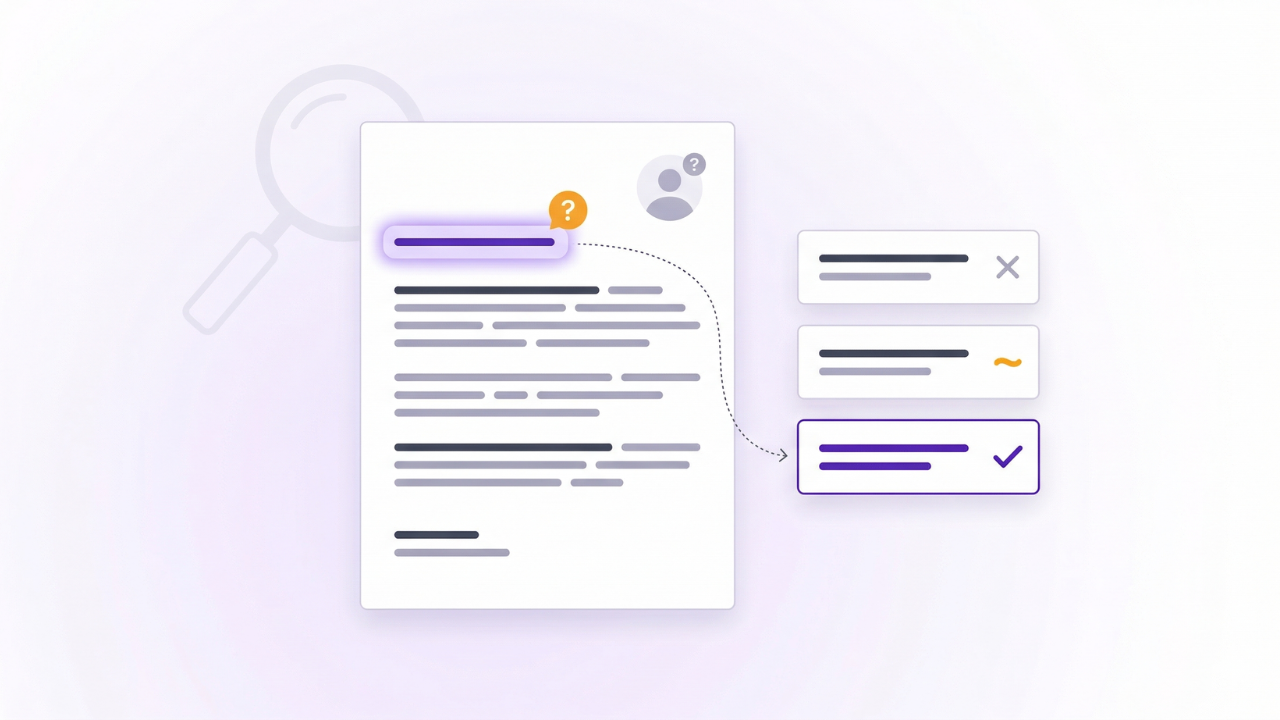
Nothing undermines a cover letter faster than an awkward greeting. "To Whom It May Concern" signals you did not bother to research the company. "Dear Sir/Madam" feels dated. Even "Hi there" can look unprofessional in the wrong context.
The right greeting is a small detail, but it sets the tone for everything else you write. This guide covers how to find the hiring manager's name, the best generic alternatives when you cannot, and exactly when "Dear Sir or Madam" and "To Whom It May Concern" are still acceptable.
Why Your Cover Letter Greeting Matters
Hiring managers read your opening line first. Before they reach your pitch, your examples, or your call to action, they read the greeting. It tells them:
- How much effort you put into research (did you find a name?)
- How up-to-date your writing conventions are (outdated greetings date your CV)
- Whether you can follow a simple professional standard
A thoughtful greeting is low-risk and high-impact. It only takes a few minutes of research and sets a confident tone for the rest of the letter.
How to Find the Hiring Manager's Name (5 Methods)
Before defaulting to a generic greeting, try these 5 approaches.
1. Re-read the job description carefully
Many postings include a recruiter's name or a hiring manager's email address. Scan the text and the footer carefully.
2. Search LinkedIn for the company
On the company's LinkedIn page, click "People" and filter by role (HR, recruiter, talent acquisition, or the hiring manager's likely title). The person who posted the job is usually the one reviewing applications.
3. Check the company's website
The "About" page, "Team" page, or "Careers" page often lists the HR lead or department heads by name. This is especially common for smaller companies and agencies.
4. Call the company's main switchboard
This takes courage, but it works. Say: "Hi, I am applying for the (role title) position. Could you tell me the name of the hiring manager so I can address my cover letter properly?" Most reception staff will help.
5. Ask your network
If you know anyone who works at the company, ask them. LinkedIn shared connections sometimes surface people who can help.
If all 5 methods fail, then move to the generic alternatives below.
The Best Generic Greetings (Ranked)
When you cannot find a name, use one of these alternatives. They are ranked from best to worst.
1. "Dear Hiring Manager"
The most professional and widely accepted modern alternative. Works for almost every industry and role type.
"Dear Hiring Manager,"
This is the safest choice when you have genuinely tried to find a name and cannot.
2. "Dear (Department) Team"
A good second choice, especially for larger companies where the hiring manager may not yet be assigned.
"Dear Engineering Recruitment Team,"
"Dear Marketing Hiring Team,"
"Dear HR Team,"
3. "Dear (Job Title Related to the Role)"
Works well if the posting suggests who will review the application.
"Dear Recruiting Manager,"
"Dear Head of Marketing,"
4. "Dear (Company Name) Team"
Acceptable in more casual contexts, particularly for startups and creative agencies.
"Dear Fieldwork Agency Team,"
5. "Hello" (context-dependent)
Only for informal, modern companies where a more casual tone is known to be welcomed. Risky in traditional industries (finance, law, healthcare).
"Dear Sir or Madam": Is It Still Acceptable?
In most contexts, no. "Dear Sir or Madam" carries three problems:
- It is dated. The phrase was common decades ago and is now associated with older template writing.
- It assumes binary gender. Many hiring teams include non-binary colleagues, making the greeting feel exclusionary.
- It is impersonal. "Dear Hiring Manager" is just as impersonal but does not feel as old-fashioned.
When you can still use it:
- Very traditional industries (e.g., some legal, academic, or government contexts) where formality is expected
- Formal business correspondence in regions where it is standard (parts of Asia, the Middle East)
- Responses to formal requests for proposal (RFPs) or tenders
Even in these cases, "Dear Hiring Manager" is usually safer.
"To Whom It May Concern": When and How to Use It
This phrase is seen as outdated by most modern career experts, but it still has a narrow set of appropriate uses.
Avoid it for:
- Cover letters (always use an alternative)
- Standard job applications
- Any context where you have time to find a name
It can still work for:
- General reference letters (not addressed to a specific person)
- Character references (for tenancy or legal use). For more, see our character reference guide.
- Bulk professional correspondence where no specific recipient is known
Capitalisation
If you must use it, capitalise all key words: "To Whom It May Concern". The capitalisation is part of the phrase's conventional use.
Greetings to Avoid Entirely
1. "Hey"
Too casual. Even in informal industries, save this for team chat, not formal correspondence.
2. "Dear Sir" or "Dear Madam" (just one)
Assuming the reader's gender is risky. If you must guess, "Dear Hiring Manager" is always safer.
3. "Good morning" or "Good afternoon"
Your letter may be read hours or days later. These greetings date the message.
4. "Dearest" or "My dear"
Too intimate for a professional context.
5. "(First name) (Last name),"
Dropping the "Dear" makes the greeting feel abrupt.
6. "Yo" or "Hi there"
Unprofessional. Never in cover letters.
Industry-Specific Conventions
Finance, law, accounting, consulting
Lean formal. "Dear Ms Chen" or "Dear Hiring Manager" always. Avoid casual greetings entirely.
Tech, startups, creative agencies
Slightly more relaxed tone is acceptable. "Dear (Name)" is still the ideal, but "Hello (Name)" can work if the company's communication style is visibly informal (check their website, job posting language, and social media).
Academia and public sector
Highly formal. "Dear Dr (Last name)" or "Dear Professor (Last name)" if applicable. Titles matter.
Healthcare
Professional titles matter. "Dear Dr (Last name)" or "Dear Ms (Last name)" is standard.
Non-profit
Can lean either formal or warm depending on the organisation's culture. When unsure, stay formal.
Full Greeting Examples for Different Scenarios
You know the hiring manager's name
"Dear Ms Rodriguez,"
"Dear Dr Patel,"
"Dear Professor Whitfield,"
You know the first name but not the last
"Dear Sarah,"
Acceptable in more relaxed industries, but always preferable to have the full name.
You know the gender-neutral name
Use the name without title if unsure.
"Dear Alex Chen,"
You know only the role
"Dear Head of Marketing,"
"Dear Director of Engineering,"
You are applying through a recruiter
"Dear (Recruiter's name),"
If the recruiter's name is in the posting or email, use it. They are the first gatekeeper.
You are submitting to a department inbox
"Dear (Department) Recruitment Team,"
What to Do If You Address the Wrong Person
If you send the letter and then realise you had the wrong name, do not try to recall it. Instead, follow up with a brief correction email.
Subject: Correction to previous application
Dear (Correct name),
I realised I had addressed my application letter for the (role title) position to a previous team member. Please find a corrected version attached. I apologise for the confusion and look forward to the opportunity to discuss the role further.
Kind regards,
(Your name)
Most hiring managers appreciate this gesture. It shows attention to detail and accountability.
Frequently Asked Questions
Is "Dear Hiring Manager" too generic?
Not if you have genuinely tried to find a name. It is the modern standard when no name is available. What feels generic is "Dear Hiring Manager" at the top of a letter that also has generic content; if the rest of your letter is specific and researched, "Dear Hiring Manager" is fine.
Should I address it to the CEO or company founder?
Only for very small companies (under 10 people) or when the founder is likely to personally review applications. For most companies, the CEO is not reviewing cover letters; the hiring manager or HR lead is.
What if the person's gender is unclear from their name?
Use "Dear (First name) (Last name)" without a title. For example: "Dear Alex Chen." This sidesteps the issue and is considered respectful in professional contexts.
Should I follow up with a phone call to find out who to address it to?
If the role is important to you, yes. A 2-minute call to reception often gets you a name. It also shows initiative, which some hiring teams notice.
Does the greeting format change for email vs attached cover letter?
No. The greeting is the same whether you are writing an email or attaching a PDF. The only difference is in the email, you also have a subject line and may not need a formal sender/recipient address block.
Is it okay to use the same greeting across multiple applications?
Only if you are genuinely addressing the same type of person (e.g., multiple "Dear Hiring Manager" greetings are fine because they do not imply personalisation). If you can find a name, always personalise.
Key Takeaways
- Always try to find the hiring manager's name first (LinkedIn, company site, job description, phone call)
- If you cannot, use "Dear Hiring Manager" as the default professional alternative
- "Dear (Department) Team" works as a second option for larger companies
- Avoid "To Whom It May Concern" for cover letters; it is outdated
- Avoid "Dear Sir or Madam" except in very formal traditional contexts
- Match the greeting formality to the industry (finance = formal; tech startups = slightly more relaxed)
- Pair your greeting with a strong opening paragraph in your motivation letter or cover letter